Showing posts with label essay writing. Show all posts

Tuesday, October 10, 2017

Using APA format in the Secondary Classroom


The vast majority of English teachers in middle and high school teach MLA formatting for essays with good reason, as it is what students will most likely be required to use in their first year of college. It is the format used for English and the Humanities, after all. 

But after having taught entry-level writing at several different colleges, I found students won't always use MLA. At one college, all freshman were required to use APA, as the school's majors were primarily in the social sciences. APA formatting is the preferred format for the social sciences, and for many students with majors and careers in these fields, MLA will be nothing but a distant memory from high school.

Teaching APA on the secondary level is useful for several reasons. The most important, perhaps, is that when taught in addition to MLA, it will prepare students for college writing. It is good for students to understand that there are different styles for different types of writing. It will increase their flexibility in the different rhetorical strategies. 

Unlike MLA formatting, APA style includes headings and sections, which can lead to more thoughtful and intuitive organization. Assigning one of the two most common APA-style papers, literature review or experimental report, will give students excellent experience in these rhetorical modes. 

APA also has many writing style rules, which can seem overwhelming on the secondary level when we are trying to teach the basics of good writing, but I've found most of these style rules are already the things we are encouraging our students to do, such as writing in active voice instead of passive voice. When I teach APA to beginning composition students, we focus on the formatting and save the style rules for more advanced classes. 

There are plenty of APA guidelines online. My favorite is the Online Writing Lab at Purdue, but if you would like some resources on the basics meant for secondary students, I've got some for your here:


Tuesday, September 19, 2017

The 5 Essays You Must Master To Be College Ready


My new book is finally available! After many years of teaching college students who are not quite ready for the demands of college-level writing, I identified the information and practice that they needed in five different rhetorical strategies to be ready. This book incorporates my most successful classroom curriculum, modified for secondary students who are homeschooled or working with a tutor or parent to enhance their skills. 

This is a full program, with exercises, step-by-step processes for each essay type, samples, and clear essay assignments for each essay type. Writing teachers will also find valuable information and projects for their classes. I'll be using it as a textbook for my future classes. 

This baby has been years in the making, and I'm proud it's finally here! Click here to purchase. 


Tuesday, September 5, 2017

Discouraging Plagiarism


The bane of my existence in teaching is plagiarism. I do everything I can to explain to students why they should not plagiarize, and I spend a significant amount of time on making sure they know what it is. I even have them take a quiz on it before their first big paper. Despite all that, there are always the cheaters.

The luxury of being a writing teacher, however, is that I can usually discourage most of the cheating by requiring a process that would make it difficult to turn in a copied paper. Here is the process that I use (which is also just a good process for writing in general):

1.  I ask a specific question, perhaps comparing and contrasting two different articles, or limiting their choice of topic. This makes it harder to find something to copy that fits the prompt. I never assign an open-ended paper.

2. I require students to turn in sources ahead of time for approval. They are free to change their minds about the sources, but they must email me links to their new sources any time before the paper is due. Sometimes, if the topic is narrow enough, I supply one of the sources as a starting point and require that they include it.

3. I assign in-class, graded assignments for the paper. Perhaps students will write two or three introductions and then do group work to determine the best introduction for their papers. Maybe I will have them free write a body paragraph, or turn in a finished paragraph for feedback.

4. I always require a rough draft and rewrites. If they do not turn one in by the deadline, they still have to include one with their final paper, or they don't get any credit.

None of these alone will deter all plagiarism, but taken together, it would be more work to plagiarize the whole process than just writing a new paper.

Most important, however, is early intervention for someone who seems overwhelmed. If a student has been absent a lot and not turning in preliminary assignments or in-class work, I take them aside and ask how I can help, and gently work into the conversation that they must be careful not to panic and do something that they would regret later. In my experience, the students who plagiarize are those who have procrastinated or tried to do a last-minute paper and gave into the temptation to try the easy way out. I tell my classes frequently that anything they can accomplish is far better than anything they can copy.

Here are some resources to help your students understand plagiarism.  The first is a free checklist you can use in your classroom and the second is a complete teaching plan with explanations, examples, exercises and a quiz.


Tuesday, August 30, 2016

Avoiding Plagiarism Handout for Students


Plagiarism is a big problem in my classroom, and it probably is in yours, too. I do my best to teach the concepts; the students know how to avoid blatant copying, but they are often tripped up on the finer points.

Recycle a paper from a previous class? Nope. But it's my own work! Still nope. Paraphrase a source without a citation? Nope. But they are my own words! Still nope.

I made this handout so there could be no confusion. For the first paper after my complete lesson on avoiding plagiarism, I have them attach this sheet and sign it.  Ignorance of the rules (meaning they tuned me out when I was teaching!) is no longer an excuse.

You can download it for free by clicking on the cover below. I hope you find it useful in your classroom!


If you would like a complete lesson plan that includes comprehensive handouts, a worksheet, and a quiz, click on the cover below. Two versions are included: MLA and APA style.

Tuesday, August 2, 2016

New MLA Guidelines - 8th Edition


When I heard the MLA guidelines were changing, the emotion I felt is best described as "Ack!"  I have spent countless hours teaching and developing resources for the seventh edition guidelines, and re-learning and changing my resources seemed like a laborious task.

When I ordered the new book, however, and sat down to read it, I immediately lost that bad feeling. Although I was comfortable with the old guidelines, I immediately saw the wisdom in the changes. In-text citations are the same, but gone are the days of the nitpicky works cited entries, where each type of resource had particular, not necessarily intuitive, specifications.

In a nutshell, the new guidelines for the Works Cited page ask for the most important features of each source. What should be included is flexible, based on the purpose of the source, and any source fits into the general formula. With more varied sources available with technology, it's a plus that you only need to know the basics to figure out how to document the entry.

Here is the list of items you should find, if applicable, for documentation, for any source:

Author
Title of source
Title of container (meaning the journal, magazine, search engine, television series etc...)
Other contributors (translator, editor, producer, etc...)
Version
Number
Publisher
Publication date
Location (URL or doi)

Once you've got these items, you can easily put together the citation, and you can add any additional helpful information.

In the MLA Handbook, they include a handy chart that also shows what punctuation to use after each entry. I've re-created the chart with some modifications for my classrooms.

For detailed information, examples, and an overall great free reference source, go to The Online Writing Lab at Purdue University: https://owl.english.purdue.edu/owl/resource/747/01/

I've also created a product with all the basics for the classroom: guidelines, examples, and charts for both in-text citations and the Works Cited entries. What I thought was going to be laborious turned into a labor of love!


Tuesday, July 26, 2016

MLA 8th Edition Resources


Here's a little video I made to show some of my MLA resources. If you have to teach MLA formatting and citations, either from scratch or just the 8th edition updates, these products will save you a lot of time and make it easy for the students. Click here to see my resources: http://bit.ly/MLAResources


Wednesday, March 2, 2016

Revising Paragraphs in Essays - Lesson Plan


My students generally write paragraphs that contain topic sentences and evidence to support their points. What they are missing sometimes is their analysis, commentary, or support for the evidence. The more common problem, though, is redundant and "fluff" sentences because the are trying to fill space, or make a point via unnecessary repetition. Of course this adds no substance, and makes the paragraph laborious to read.

The method contained in this lesson plan will have students analyze each sentence in their paragraphs to make sure they have purpose. They can easily recognize the fluff and redundancies. It will also help them understand when they are missing important elements. Click on the photo above to get to the product.

Here's to better paragraphs!

Tuesday, February 23, 2016

Thesis Statement Activity


A solid thesis statement is critical to the success of any essay, but I often find my students disengaged while I try and teach them the fundamentals. Out of desperation, I tried this activity, and it was a resounding success. I saw improvement immediately on the practice thesis statements used for the activity. That improvement then translated into their next essays. Yes, there was a bribe involved, but whatever works, right?

Here's the activity, which should be used directly after instruction on how to write a thesis statement:

1. Give the class an interesting reading or show a short video about a topic that is ripe for varied opinions. I like to show this seven-minute clip about AutoTune from Nova:

https://www.youtube.com/watch?v=9OUgXFZ_WeY

2. Facilitate a short class discussion on the topic to get them thinking about the pros and cons. For the AutoTune example, we talk about whether an artist who uses AutoTune in a live concert or on a recording is deceiving the audience. We talk about the common use, the ethics, and whether the audience should be aware of its use.

3. Ask them to write a thesis statement about the topic (as if they were going to use it for an essay). Tell them not to write their names on the paper.

4. Collect all the papers, shuffle them, and redistribute. Ask students to carefully read the thesis on the paper they have.

5. Now ask all the students to stand up.

6. One by one, go through the points of a good thesis statement. For example, say, "Does it contain a clear opinion?" Have the students consider the thesis and sit down if it does not meet the criteria.

7. When you have only a few students left standing (or have gone through all the criteria), have the class vote on the best thesis still remaining.

8. The writer of the winning thesis gets a prize! (I like to give out colorful Sharpie pens.)

I've done this for several quarters now, and the students always show improvement, I think because they are so engaged in the process, whether in writing their own thesis or evaluating others' thesis statement.

If you need a lesson for writing a thesis statements, here's the one I use. It's a Power Point presentation, along with handouts and worksheets.


Tuesday, September 8, 2015

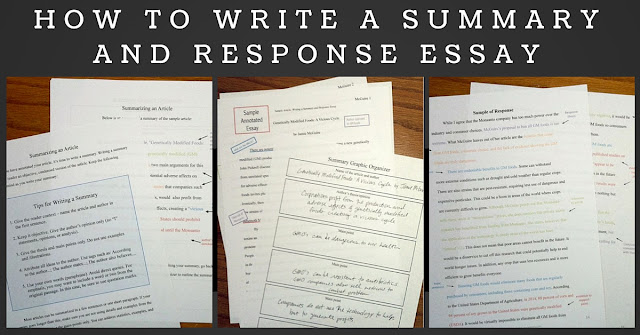
Summary and Response Writing

https://www.teacherspayteachers.com/Product/Summary-and-Response-Essays-Complete-Unit-1729917
Before we begin a research paper in my composition classes, we start with a summary/response essay. I find that if students master the skills of the summary/response essay, they will be well prepared to take on the larger project because it breaks down the process of a research paper into manageable steps.

First, it requires a close reading of a qualified academic source. These types of sources are usually not easy reading, so it will push the students to pay close attention, annotate, make notes, and perhaps cross-check facts, and seek alternative opinions for background. I require an annotation of the chosen article for the first assignment for this essay.

Next comes a summary, which will become the first paragraph of the essay. A good summary follows these guidelines:

1. Gives Context: Name the author and title of the article in the first sentence. In the article xxx, by xxx, the author states......
2. Contains the main ideas only: The thesis and the main points of the article are all that is necessary in a summary. Leave out examples, illustrations, and details.
3. All ideas are attributed to the author: The reader should always be reminded that these are the ideas and thoughts of the author, not the essay writer. Jones believes......  or  According to Jones.....
4. Objective: The essay writer should offer no opinions or analysis in the summary. Statements such as Jones makes a good point when she says... are not objective, because "good point" is subjective.
5. Paraphrase: Use your own words. Direct quotes should be rarely used.

After the summary, the rest of the essay is structured like a traditional essay, with a thesis statement, body paragraphs and a conclusion. The difference is that the whole essay should stay tightly focused as a response to the article. A thesis statement might be structured something like this: Although Jones makes a strong argument about x, she does not consider x.  Or:  I agree with Jones about x, because this is a problem that is often overlooked in the mainstream media. 

I require students to quote or paraphrase from the article frequently in their response to make sure they stay focused. It's easy to stray far from the article, especially if the student has strong feelings or a lot of knowledge about the topic. By requiring this kind of focus, it helps students master the skill of integrating sources.

I also require students to use only the one source for this essay to keep it simple.

After the summary/response essay, students can directly transfer the skills to writing a research paper with multiple sources.

I've had great success with this type of essay in my classroom. Not only do students typically score well on this assignment, it gives them the confidence and skills to move forward.

If you would like a prepared summary and response unit, I have one here that includes samples of an annotation, summary, response and complete essay. It also includes step-by-step instructions for the whole process, along with worksheets, graphic organizers, grading rubrics, and  more.

https://www.teacherspayteachers.com/Product/Summary-and-Response-Essays-Complete-Unit-1729917

Tuesday, April 21, 2015

A Better Way to Correct Essays

https://www.teacherspayteachers.com/Product/Essay-Revision-Error-and-Progress-Logs-1815517

I offer significant points for turning in rough drafts because revision is the most important part of the writing process. I have had much success in getting the students to do this part of the assignment, but one issue lies in how effective my feedback is regarding punctuation and grammar errors, and whether students can, or are motivated to, successfully translate my comments into improved writing and learning.

What not to do: proofread and edit. Not only is this time consuming, it is ineffective. Case in point: On one student's essay, I did comprehensive line editing, pointing out every grammar and punctuation error and providing the correction. Not only was the paper almost unreadable when I was finished, cluttered with the highlights and dialogue boxes, but it had no effect on learning. The paper had the simple errors corrected on the final draft which seemed like a success at first. Then I got to the end of the essay, where the writer had made a great point in the last sentence. I responded, "Indeed!"  Guess what the new last sentence of revised essay was? Indeed.

Insert wah-wah-wah fail music here. Transcribing is not learning. It is difficult for me to turn off my compulsion to correct all errors, but what I do now is use a code for each type of error, say a comma splice, and I do not correct it. The student matches the error code to a provided key, and logs a revision. I might give an example of a correction, but more often, I list the page number in their reference books that explains the concept if I think the student might not know how to correct the error.

They don't always get the corrections right, but they learn far more than mindlessly transcribing my corrections. First, they have to look up what the errors are, and figure out how to correct it on their own. They earn points for correctly revising one example of each type of error they make. Although I see fewer perfectly corrected papers, I see fewer recurrences of problem areas in subsequent drafts, and that's really what it's all about.

To see examples of my codes and logs, or if you want to buy mine instead of making your own, click here.

https://www.teacherspayteachers.com/Product/Essay-Revision-Error-and-Progress-Logs-1815517


Tuesday, April 14, 2015

Point of View in Academic Writing - the Ubiquitous "You"


When reviewing student drafts of academic essays, I find myself constantly marking the use of second person. With no direction, I find most students use second person. With direction, I find most students still slip into second person.

There are many reasons why second person is the go-to point of view for first drafts. It is the most informal and conversational. Students tend to write like they talk, so second person is natural. They also read a lot of second person online; advice articles, how-to, and informal blogs tend to use second person.

Second person, however, is the point of view that should be almost never used in academic writing. Besides the informality, which is inappropriate in a research paper and other academic essays, the main reason second person is not preferable is because it excludes or alienates part of the audience.

I use a few humorous examples to show this, and that is when it usually clicks with students. For example, I first ask the students, "Who is the audience for this paper?" The typical answer is me, the teacher, but we also discuss that it is anyone who is interested in the topic. Then I read the following passage from a student paper about preventing teen pregnancy:

"You should discuss your sexual activity with your parents or another adult because studies show that if you do this, your chances of pregnancy go down significantly."

I ask the students if I should discuss my sexual activity with my parents or another adult. I also ask a male student if this advice will help reduce his chance of pregnancy. Of course they immediately understand my point, and we don't need to elaborate on how second person excludes part of your audience.

We also review how the tone of this passage is more like a self-help article than academic research. Then I show a simple rewrite:

"Teen girls who discuss their sexual activity with their parents or another adult have a significantly reduced rate of pregnancy" (Smith 21).

There will always be the ubiquitous "you" in student papers, but a simple example requiring students to think about their audience will help them revise correctly.


If you are looking for resources to teach point of view, here is the Power Point and rewriting exercises I use with my classes: 

https://www.teacherspayteachers.com/Product/Point-of-View-in-Academic-Writing-1798737

Tuesday, September 23, 2014

Peer Reviews - More ideas

 I've recently come across some great blog posts with more ideas for peer reviews and editing. I wrote a blog with tips for peer reviews here, but there are many methods out there. I intend to try all three of these.

From The Doc Is In comes this fast-paced, focused, round-robin-style editing. The time allowed seems a little short to me, but that can be easily remedied:

http://drpezz.wordpress.com/2013/12/01/peer-editing/


From Teaching the Teacher is this method using Google drive:

http://1brainsandwich.blogspot.com/2013/06/peer-editing-using-google-drive.html

Finally, the High School Bits blogs offers one teacher's method of using class discussions and having the whole class review the same few pieces at the same time:

http://blogs.bedfordstmartins.com/highschoolbits/peer-review/test-post-for-robin-aufses/

Tuesday, September 9, 2014

Tips for Effective Peer Reviews


Peer reviews of rough drafts can be a valuable tool in the classroom, but they can also be a disaster. Some students are resistant to others reading their work, while other students lack confidence in their critiquing skills. Early in my teaching career, I simply gave students a pep talk and let them critique each others' papers with little direction. This was a mistake, because it fed into both of these problems, and the results were not helpful to the students. What we ended up with was hit-or-miss proofreading rather than big picture critiques. Here are some tips that have led to effective peer reviews in my classroom:

1. Write specific items to look for on the whiteboard, or pass out a handout. These will vary depending on the type of writing, but some sample items from an argumentative research paper might be:
  •    Highlight or underline the thesis statement. Does it contain a clear argument?
  •    Does the author address the counter argument?
  •    Is the introduction engaging? Does it make you want to read the rest of the paper?
  •    Read the introduction and the conclusion together. Do they work together?
  •    Are all the author's points supported by sufficient research
Remind students that they are not proofreading. I encourage students to mark on the drafts, but also to have a conversation with the author, because sometimes they can't fully express their comments on the paper.

2. Require the students to point out the positive aspects of the paper along with what needs to be improved.

3. Encourage writers not to get defensive when receiving the critique. I tell the students that their job is to listen carefully to the critique, then decide whether to make a given change or not. Some students feel obligated to act on every piece of advice they get, but I caution them to retain ownership of their papers, and make judicious decisions.

4. If you have students who are sensitive about sharing their drafts, you can instruct students to bring anonymous drafts, or allow them to choose their own critique groups.

5. Three to four critiques of a draft is a good number. This will allow the writer to see if readers agree on points of improvement, or if there is a difference of opinion.

5. I end the critique with a "Next Step" assignment, where I ask students to list the three most important things they learned about their paper in the critique groups, and what they are going to revise. This allows them to synthesize the information and make better revision decisions.

Regardless of whether the author gets useful advice from the reviewer, the reviewer always benefits by becoming more aware of how to read like a writer, and hopefully picks up some revision ideas for his or her own essay.

http://www.teacherspayteachers.com/Product/Essay-Writing-Bundle-1359702
  

Friday, August 8, 2014

Writing Prompts for Research Papers


I like to let my students choose their research paper topics, unlike some of my colleagues who assign topics. I believe if students are interested in their topics, they will be more fully engaged and get more out of the whole process. With a topic they care about, they are less likely to view the assignment as hoop jumping, and invest more energy and time into it. 

That said, it has never worked well just to say, "Choose whatever you want to write about." Most students are like deer in the headlights - they have no idea where to go or where to start. I used to write a list of previous topics that worked well on the whiteboard, but that was ineffective.

What did finally work was when I gave some topic ideas, and then posed some questions to think about, along with ideas for research.

For example, most students were not excited about the topic of genetically modified foods, until I posed a few questions for thought: "Should genetically modified foods be labeled?"  "What should the government's role be in oversight, testing, and labeling?"  "Why would voters shoot down a proposition in California requiring labeling?"  Once we talked about these, then I asked for questions about the topic to research: "What measures have other countries taken against genetically modified foods?"  "What do studies show about safety?" By the end of the discussion, I had a few enthusiastic takers.

I got the idea to make a set of cards with topic ideas, questions to consider, and research ideas. This way, students can flip through them and see what speaks to them. The best thing is that most use the cards as a starting point, and end up with a unique spin on the topic.

I recommend doing this in your own classroom if you want students to choose their own topics, or you can limit the topics to a few of the cards you have made. Either way, it gets everyone off to a great start.

If you don't want to make your own, I've compiled 40 ideas that students have used successfully and put them on half-sheet cards. I've also added a full-color Power Point so you can use the ideas one at a time for discussion or response papers. Click here to see the product.


http://www.teacherspayteachers.com/Product/Writing-Prompts-Research-Papers-and-Response-Papers-1329353

Friday, March 15, 2013

What's in the Sack? Group Brainstorming Activity


Whether your students are preparing for a big essay assignment or a quick in-class effort, coming up with a topic to write about can be the hard part. Here is a fun activity I've used with my classes with good results. It loosens up the thought process, and is a nice change of pace.

Divide the class in to groups. Give each group a bag with six everyday items in it, such as a rock, a deck of cards, a piece of fruit, a magazine, a quarter, etc....Set a timer for two minutes and have the group pull one item out of the bag. During the two minutes, the group should come up with as many topic ideas as possible related to the object. For example, if the group pulls out the quarter, some topic ideas might be money management, saving strategies, summer jobs, economic policy, reward motivation, allowances from parents, getting paid for good grades....Tell the students to list everything that comes to mind without editing. The more ideas, the better. After the activity, have each group share of few of their best ideas for each object with the whole class.


Tuesday, November 13, 2012

Evaluating Sources Prompt - Bottled Water

It's important to teach students to use qualified academic sources in their papers. The temptation is to use the easy, entertaining stuff they find on the internet instead. Here is a classroom activity to start a discussion and use as a writing prompt.

1. Show the video "The Story of Bottled Water."


2. After the video, have a brief discussion of the issues. Now show the video "The Real Story of Bottled Water."


3. Have a discussion on why or why not either of these are credible sources. (They are not--one is inflammatory, for example, it compares drinking bottled water to smoking while pregnant, and one is put out by a trade association with a commercial interest). Ask students what questions they have now, what information they can use or trust, and how to go about verifying facts and getting the real story.

4. At this point, I ask students to find a good academic source, and write a response to the issue based on the credible information they find.

An important concept the students learn is that unqualified sources such as the videos are good starting points for asking questions and learning what the conversation is all about, but that in order to be a good research, facts must be verified.

Friday, October 26, 2012

Writing Thesis Statements

Writing thesis statements strikes fear into many students' hearts. I have developed a way of getting from a broad topic to a thesis statement that makes it much easier.

First, they think of a broad topic they would like to use and write it down. Then, I ask them to come up with as many questions about the topic as they can think of. When that's done, they do some preliminary research or freewriting to come up with an answer to that question. That answer then becomes the controlling idea, and the thesis comes from that.

For example, if my topic is texting and driving, one of my questions is "Is it really that dangerous?" I find out from research that reaction times are similar to drinking and driving. So my thesis statement is my topic, plus my controlling idea and opinion: Texting and driving is as dangerous as drinking and driving, so the penalties should be the same.

I put this idea with a worksheet, along with everything else I use for helping students write good thesis statements (handouts and worksheets, plus a power point) in this new packet. It's in my teacherspayteachers store for only $3.00. Happy writing!

Wednesday, October 17, 2012

Writing Prompt - Videos for College Applications?


This week's writing prompt is about whether students think videos should be part of the college admission's process. Some universities are now accepting videos in lieu of, or in addition to, the traditional written essay component.

I have my students read an article about it, and then watch actual video submissions. The article is here. Links to the videos are embedded in the article, and two are below.

I would think that my students would embrace the idea of using videos instead of writing essays, but surprisingly, they seem to understand the importance of showing communication skills on paper. After a class discussion, I have them write for thirty minutes.

The purpose of this writing prompt in my classroom is to demonstrate competency in incorporating outside sources to back up opinions. Here is the actual assignment:


Please read the article about You Tube college applications and watch the video clips.

Write a one-page opinion piece (about 30 minutes effort) on whether or not you think videos should be part of the college application process and possibly even replace the written essay requirement. Use specific examples from the article and the videos.

Grading criteria:

30 minutes effort
Contains a clear opinion/thesis statement
Specific examples from the article and videos used to back up opinion.


Tuesday, September 18, 2012

Paper Topic Brainstorming Activity

Coming up with a topic for a research paper is one thing, but figuring out a narrow direction to pursue is quite another, and one where students often get hung up. This activity uses the brainpower of the entire class to help find that direction.

Tape one large piece of paper for each student on the wall around the classroom. Give everyone a colored marker and have them stand in front of their papers. Ask everyone to write their topic in the center of the paper and circle it.

Now, have everyone rotate so they are standing in front of someone else's paper. Allow 30 seconds for students to write everything they can think of about the topic, using a mind-map style web. They can ask a question, add a subtopic, make a comment--whatever comes to mind.

Rotate again, and keep going until everyone has had a chance to respond to everyone else's topics. You will need to extend the time as the papers fill up, because it will take students longer to review what has already been written.

If you have a small classroom with no space for the paper on the wall, this activity works just as well using large paper (I used 11 x 17) passed along desktops. If you can, though, use the wall because it's  a great opportunity to get students up and moving, and if nothing else, it's fun to write on the wall.

At the end of the activity, each student can take their own paper and see what everyone else has to say. Perhaps they will find an interesting question or a direction they hadn't thought of before. My students find it very helpful, and some even switch topics to something else they found on the wall that seemed more interesting.


Sunday, April 15, 2012

Tax Day Sale

I'm having a sale through tomorrow - 15 percent off everything in my store. I only do this about once every six months, so head on over if there's something you've been wanting.

http://teacherspayteachers.com/Store/Laura-Torres


I just posted my latest product - Revising Paragraphs. This is an effective way for students to self-edit using a color-coding system to make sure every sentence in a paragraph counts, and that the sentences are in a logical order. Complete lesson plan includes everything you need.