Showing posts with label grammar. Show all posts
Tuesday, August 29, 2017
Every day vs. Everyday
The most common mistake I see in commercial signage, besides apostrophes, is using "everyday" instead of "every day." It drives me crazy because the difference is simple, and they mean different things. You would think that before a company would spend thousands of dollars printing their ads, they would have a proofreader look it over. Does this grate on anyone else's nerves as much as mine? Below are two of the latest offenders. Props to Firehouse Subs, though, for using an apostrophe appropriately in Kids' Combo.
It's also not unusual to find "everyday" and "every day" in student writing. No wonder, since the misuse is everywhere. Here's the simple rule, and a few examples to help ground them in their memories:
Everyday is an adjective that means "routine, usual, or mundane." Examples: You don't want to wear your everyday clothes to the wedding. Snow is an everyday event in the winter here. Paper plates are our everyday dishes.
Every day means "each day." Examples: I eat oatmeal for breakfast every day. Every day is a new start. Someone has to walk the dog every day.
To remember the difference, just remind students that if they can substitute "each day" then "every day" is correct. So the signs above should read "Kids 12 and Under Eat Free Every Day after 4 pm" and "Eat at least 6-8 servings of fruit and veggies every day."
Easy, right? Now if I could just stop seeing these mistakes every day!
Tuesday, January 10, 2017
Out with the Comma? Joining Independent Clauses
English has many grammar and punctuation rules, but there are many exceptions to those rules.
This is what I've always taught in my classes, no exceptions. Now, however, I can't ignore the exception to this rule because it's becoming more common in publications, and my students notice.
If the two independent clauses are short, closely related, and if the comma is omitted, there is no misunderstanding. For example:
He completed the assignment but it was late.
It's not new; it's in the Chicago Manual of Style and the MLA Style Guide, among others, but it's been largely ignored and doesn't come up in most shorter official grammar guides.
The trend is definitely toward minimal punctuation, so I'm getting on board teaching the exception, but only so my students will understand when they see it in print. I will, however, require my students to continue to use the comma in their formal writing assignments so I'm sure they understand the rule, and it's not a purposeful omission. I explain that you can't go wrong with the comma. My students know my mantra: Learn the rules (and demonstrate your understanding) before you break them.
Friday, November 25, 2016
Cootie Catchers to Review Grammar
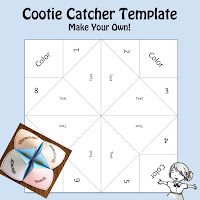
There are many ways to use Cootie Catchers. My favorite is to have a "speed round" where students, in pairs, go as quickly as they can to answer three different questions from a single Cootie Catcher correctly. When the first partner has done so, they switch places and the second partner has to answer three questions correctly from a different Cootie Catcher. The first pair to finish wins.
Below are instructions for folding and using a Cootie Catcher, and some links to the ones I have made to review grammar. If you want to make your own, click here for a free template.
Tuesday, September 27, 2016
Will "Ze" Ever Be?
In my last blog (click here) about my support for standardizing the singular use of the pronoun "they," I glossed over one of the central issues, which is the use of the gender-specific pronouns "he" or "she."
Using "they" is not a perfect solution to this problem because there are times it doesn't make sense.
"Each student must turn in their assignment by tomorrow" is a sentence where "they" flows seamlessly and does not cloud meaning. There are multiple students and each is turning in an assignment. The plural here makes some sense, even if it doesn't traditionally agree. This is how we generally speak, and most would not even notice there is a technical error here.
"Erin must turn in their assignment by tomorrow" however, sounds strange. Even worse, what if we are still talking about Erin, but want to avoid "he" or "she" (perhaps we don't know Erin's gender, or perhaps we are uncertain of Erin's preferred pronoun): "They need to pick up their reading log at the library." This is where "they" doesn't work. It's not a matter of agreement, it's a matter of defining who we are talking about in the first place. We are talking about one person here, not a group of people.
Enter the latest gender-neutral pronoun "ze." It would be nice to solve this problem that easily. Ze is not the first gender-neutral pronoun that has been proposed, but it has gained some traction. The problem is, I don't see it being accepted anytime soon in common usage. The reasons are not because it is not practical (it is on every level), but because this type of fundamental change in language is difficult.
There are words like "blog," "crowd fund," and "tweet" that didn't exist a few years ago but were easily accepted and widely used now, but those are different because they stand for new concepts that needed words. Changing our use of common pronouns is an entirely different matter. It would have to be conscious, careful, and widely understood and accepted. In other words, a deliberate cultural effort.
In addition, the learning curve is high. When ze (subject) is used as an object, it is "hir" (pronounced here), as a possessive pronoun, it is "hirs" (pronounced heres), and as a reflexive, it is "hirself" (pronounced hereself). The use of these unfamiliar pronouns is not intuitive or currently understood by most. (As I type these words, auto-correct is doing its best to "fix" them.)
A change like this is not going to come easy, even in academia. When I offered it as an alternative to my first-year college freshman class at a very liberal college, not a single student adopted the practice, even though some were careful to give me their preferred pronoun on first roll call.
I believe a gender-neutral pronoun will someday be adopted by English speakers, and should be for practical reasons, but I would guess it will be decades from now. In the meantime, "they" is the best we can do.
There are words like "blog," "crowd fund," and "tweet" that didn't exist a few years ago but were easily accepted and widely used now, but those are different because they stand for new concepts that needed words. Changing our use of common pronouns is an entirely different matter. It would have to be conscious, careful, and widely understood and accepted. In other words, a deliberate cultural effort.
In addition, the learning curve is high. When ze (subject) is used as an object, it is "hir" (pronounced here), as a possessive pronoun, it is "hirs" (pronounced heres), and as a reflexive, it is "hirself" (pronounced hereself). The use of these unfamiliar pronouns is not intuitive or currently understood by most. (As I type these words, auto-correct is doing its best to "fix" them.)
A change like this is not going to come easy, even in academia. When I offered it as an alternative to my first-year college freshman class at a very liberal college, not a single student adopted the practice, even though some were careful to give me their preferred pronoun on first roll call.
I believe a gender-neutral pronoun will someday be adopted by English speakers, and should be for practical reasons, but I would guess it will be decades from now. In the meantime, "they" is the best we can do.
Tuesday, September 20, 2016
It's Time to Standardize the Singular "They"
I am a fan of the English language and all the messy rules that go with it. I resist change. In formal writing, I do not begin my sentences with coordinating conjunctions. I do not press "send" until I have proofread my text messages. Yes, I am one of THOSE people. I am, however, on the bandwagon to standardize the singular use of the plural pronoun "they."
Using "they" as a singular pronoun is, by far, the most common mistake in student writing, but perhaps it should not be considered a mistake at all, rather a better option than the clunky and binary "he or she."
Besides the obvious binary gender issue, which is important to many of my students, there is one big reason why "they" should be an acceptable singular: efficiency of language.
Consider this sentence:
Kelly or Brennan will organize the committee, but ? or ? will need help with the finances.
The names Kelly or Brennan are gender-neutral, but require a singular pronoun, according to the rules (if it were "Kelly and Brennan," then the plural "they" would be the correct pronoun), so what if the writer doesn't know whether "he" or "she" is appropriate? Consider the sentence, written according to the rules, even if the writer does know the genders:
Kelly or Brennan will organize the committee, but she or he will need help with the finances.
Clunky. It would be easy to make a case for the plural "they" here instead of the "she or he," or guessing the gendered pronouns (or the untenable "...but he/she or he/she...).
The stickler on my shoulder says, "There could be a misunderstanding! Someone might think Kelly and Brennan are working together!" Granted, the first part of the sentence is clear that one or the other will organize the committee, and the second half states that both of them will need help, but to me, the flow of the sentence with "they" trumps any confusion.
Also consider the most common situation where "they" would make sense:
If a student wishes to enroll after the deadline, he or she will need to take his or her petition to the academic counseling office.
There are a lot of extra words in that sentence and the flow is not good. Previously, if I saw this sentence in an essay written like this, "If a student wishes to enroll after the deadline, they will need to take their petitions to the academic counseling office," I would suggest changing "a student" to "students" rather than changing the pronoun "they" to "he or she" and "his or her." This is a cop-out, because it's simply a workaround to a greater problem. Now, I just let it be, because, frankly, the pronoun "they" works better.
It will be an uncomfortable shift for those of us who make our livings sussing out the small errors of the written language, but I suspect for almost everyone else, they will be surprised (if they give it any thought at all) that using "they" as a singular was ever incorrect.
Tuesday, April 5, 2016
Teaching Active and Passive Voice
Teaching active and passive voice is a bit of a challenge. Most older students have heard of passive voice, and know they shouldn't use it, but have difficulty identifying it. It gets even more challenging to teach when I explain that it's not technically grammatically incorrect. Writing in active voice is a best practice; in fact, there are times when passive voice might be necessary or preferred. (Can you just see the students checking out?) So why, then, teach active and passive voice at all?
The short answer is that active voice is more direct and clear.
Active: Andrew ate the burrito.
Passive: The burrito was eaten by Andrew.
Passive: The burrito was eaten.
In the active example, the sentence is straightforward. Subject (agent of action), verb, object.
In the first passive example, the agent of the action (Andrew) and the object (the burrito) are flip-flopped. It also contains more words with the addition of "was" and "by."
In the second passive example, we don't even know who ate the burrito!
This is a simplistic example, but you can see how clarity can suffer, especially in a complex sentence when the agent of the action is missing. Students who understand the difference between active and passive voice are more efficient, effective writers. I like to use a cooperative game to engage students. You can find the one I use here.
Politicians love passive voice: "Mistakes were made." How's that for avoiding responsibility?
Vote "No" for passive voice!
Tuesday, April 21, 2015
A Better Way to Correct Essays
What not to do: proofread and edit. Not only is this time consuming, it is ineffective. Case in point: On one student's essay, I did comprehensive line editing, pointing out every grammar and punctuation error and providing the correction. Not only was the paper almost unreadable when I was finished, cluttered with the highlights and dialogue boxes, but it had no effect on learning. The paper had the simple errors corrected on the final draft which seemed like a success at first. Then I got to the end of the essay, where the writer had made a great point in the last sentence. I responded, "Indeed!" Guess what the new last sentence of revised essay was? Indeed.
Insert wah-wah-wah fail music here. Transcribing is not learning. It is difficult for me to turn off my compulsion to correct all errors, but what I do now is use a code for each type of error, say a comma splice, and I do not correct it. The student matches the error code to a provided key, and logs a revision. I might give an example of a correction, but more often, I list the page number in their reference books that explains the concept if I think the student might not know how to correct the error.
They don't always get the corrections right, but they learn far more than mindlessly transcribing my corrections. First, they have to look up what the errors are, and figure out how to correct it on their own. They earn points for correctly revising one example of each type of error they make. Although I see fewer perfectly corrected papers, I see fewer recurrences of problem areas in subsequent drafts, and that's really what it's all about.
To see examples of my codes and logs, or if you want to buy mine instead of making your own, click here.
Saturday, October 18, 2014
Tips for Teaching Grammar When You're not Supposed to be Teaching Grammar
The composition class I have been teaching for years is supposed to be all about research, critical thinking, and honing argumentative writing techniques. The students, allegedly, have already mastered basic grammar and writing skills. After the diagnostic essays on the first day, however, the same story emerges: the grammar mastery is shaky at best, and non-existent at worst. Over time, the topics that need the most review have held steady, and my teaching has evolved to meet this need.
Most of my students have gaps in their early education, or are returning to school after many years, so I am not so concerned that every student knows what a dangling whoseewhatsit is, but they need to review or be taught some basics in order to begin to present a coherent argument. The rest of it can be taken care of through critiques on their rough drafts. Through trial and error, and ultimately modest success, here are my best tips for teaching grammar when the class is supposed to be at the next level:
1. Couch everything as a "review" since you will have students for whom it is, indeed, review.
2. Even though it's a "review," start with the basic rules and don't assume previous knowledge.
3. Keep the terminology as basic as possible.
4. Start with a review of the parts of speech. I use a cooperative game for this one, and call it an "English Class Ice-Breaker," rather than a formal lesson.
5. Teach sentence fragments and clauses first, then move on to run-on sentences. These two items are the crux of most of the issues, and writing improves significantly with these two errors corrected.
6. Keep the lessons short and to the point. I use a short power point, handouts with the explanations they can study at home, and self-check practice quizzes.
7. Check for understanding with a self-check quiz. Offer to meet with the students who need more help or provide more resources. I often send students to interactive websites for practice. My current favorite is chompchomp.com.
8. Have students keep an "error journal" where they keep track of where they are making mistakes on their rough drafts. This will help them be self-aware and hopefully, self-correcting.
9. Do short writing exercises to practice the skills your class is really about, but each time, give special emphasis to one point of grammar and grade accordingly.
I would love some feedback on how you teach grammar in the classroom under similar circumstances.
If you'd like to use my resources, which include power points, worksheets, handouts, games, quizzes, and two comprehensive assessments, I've put them altogether in a money-saving bundle. These are what I use each quarter in my class. I hope you find them useful.
Monday, January 14, 2013
Clause Confusion
It's been a while since I taught clauses to my students, beyond dependent and independent clauses. The section in our book on the subject was not clear at all, and I felt like I needed to brush up on the topic myself anyway, so I started researching from different sources. Wow. I ended up completely confused. Not only does it seem there is no consensus on the major categories, but they are often called by different names.
So, I sifted through all the resources I could find, and after one big headache, boiled it down what I think is the latest and greatest thinking on the subject, and included the categories that made the most sense for students: Independent, Dependent, Relative, Nonrestrictive, and Restrictive. Although I looked at a plethora of sources, the one that most informed my choices was from the online library at the University of Phoenix.
This power point is a great starting point for clearing up clause confusion. It has explanations and clear examples. I used it in my classroom this quarter, and the test scores on the subject confirmed that it helped. I hope you will find it helpful, also.
So, I sifted through all the resources I could find, and after one big headache, boiled it down what I think is the latest and greatest thinking on the subject, and included the categories that made the most sense for students: Independent, Dependent, Relative, Nonrestrictive, and Restrictive. Although I looked at a plethora of sources, the one that most informed my choices was from the online library at the University of Phoenix.
This power point is a great starting point for clearing up clause confusion. It has explanations and clear examples. I used it in my classroom this quarter, and the test scores on the subject confirmed that it helped. I hope you will find it helpful, also.
Ho, ho, ho!
Wednesday, August 15, 2012
Teaching Active and Passive Voice
Recognizing the difference between active and passive voice doesn't come easy for some of my students, so I broke it down in a simple, visual way that has helped tremendously. The terminology of parts of speech can throw them off, too, so I use the words that make sense rather than the technical terms (although I teach those, too, for accuracy's sake.) To illustrate active voice, I draw this guy on the board:
Andrew is eating the burrito.
I explain that we have the agent (or do-er) of the action first (Andrew), and the thing that is being acted upon second (the burrito).
For one passive voice construction, I draw the same image, only flipped, on the board:
The burrito is being eaten by Andrew.
Now, the thing that is being acted upon (the burrito) comes first and the do-er is second. For the second passive construction, I just draw the burrito:
The burrito was eaten.
Now, there is no do-er of the action. So for any simple sentence, I ask them to visual a picture according to the order laid out in the sentence, and unless the do-er of the action is first, it is a passive construction. By getting this simple foundation, the students are ready to move on to more complex construction and higher concepts.
Here's the lesson plan I put together on this, which includes the above, plus some worksheets and a quiz. Now, I'm going to eat a burrito!
Thursday, April 19, 2012
Grammar Police

Yesterday morning, I decided to ask my students next quarter to be on the lookout for grammar and punctuation errors in the real world. I was considering how hard this would be and if I should assign points for the assignment.
I left the house and went through the McDonald's drive-thru (through?) on the way to work. Bingo! How easy was that? Five minutes out in the world and there was a glaring misuse of the poor, embattled apostrophe. The girl probably wondered what I was doing as she tried to hand me my drink and I was busy taking a picture with my iphone. I'm definitely going to make this an assignment, with bonus points for a photo. Unfortunately, it shouldn't be hard.
Have any of you assigned something similar? I'd love to hear how it worked out!
Subscribe to:
Posts (Atom)