Showing posts with label language arts. Show all posts

Tuesday, November 14, 2017

Sojourner Truth Speech Writing Activity


Sojourner Truth's "Ain't I a Woman?" speech is short and powerful. I assign this reading during our argumentative essay writing unit and then we analyze it for logic and persuasive techniques.

I recently started assigning a writing activity to go along with it, and it was successful. I got some of the best writing out of my students all quarter because they wrote passionately.  Here's the prompt:

Write a short, logical, persuasive speech defending yourself against something you have been denied or a stereotype or misconception about you.

Some examples of something students have been denied are attending an event or place because of age, a request to a parent (allowance, pet, expensive clothes...), membership in a club, a job they applied for, or a class change. Examples of stereotypes of misconceptions are that video game players are lazy, people who get good grades are nerds, athletes are not smart, or girls are too dramatic.

My students had no problem coming up with something. In fact, many immediately started writing the second I finished writing the prompt. The examples I gave were light-hearted and some were silly, but some students wrote about very serious racial stereotypes and misconceptions, and they said it felt good to be able to communicate what they felt.

 Here's a link to "Ain't I a Woman?" if you want to give this a try:

https://sourcebooks.fordham.edu/mod/sojtruth-woman.asp


Tuesday, October 3, 2017

Success Writing Prompts - Four Rhetorical Strategies


There are a lot of good writing prompts out there that ask for an opinion, but there are few that ask for rhetorical strategies beyond that. I created this product to help students practice writing with different methods - expository, narrative, persuasive, and research-based. Each prompt has a quote from a famous person on an aspect of success, and then a writing prompt that promotes critical thinking. Students write in the mode specified at the top of the page. There are ten for each strategy.

I also created this product in three versions for maximum flexibility: print, digital (for Google Drive and MS One Drive), and a Power Point presentation. Whether you want to hand out copies for students to write on, have students write on the computer, or project a slide and have students use their own paper, you're covered. Click on the picture above or here to get to the product preview.


Tuesday, August 29, 2017

Every day vs. Everyday


The most common mistake I see in commercial signage, besides apostrophes, is using "everyday" instead of "every day." It drives me crazy because the difference is simple, and they mean different things. You would think that before a company would spend thousands of dollars printing their ads, they would have a proofreader look it over. Does this grate on anyone else's nerves as much as mine? Below are two of the latest offenders. Props to Firehouse Subs, though, for using an apostrophe appropriately in Kids' Combo.


It's also not unusual to find "everyday" and "every day" in student writing. No wonder, since the misuse is everywhere. Here's the simple rule, and a few examples to help ground them in their memories:

Everyday is an adjective that means "routine, usual, or mundane."  Examples: You don't want to wear your everyday clothes to the wedding.  Snow is an everyday event in the winter here.  Paper plates are our everyday dishes.

Every day means "each day."  Examples: I eat oatmeal for breakfast every day. Every day is a new start. Someone has to walk the dog every day.

To remember the difference, just remind students that if they can substitute "each day" then "every day" is correct. So the signs above should read "Kids 12 and Under Eat Free Every Day after 4 pm" and "Eat at least 6-8 servings of fruit and veggies every day."

Easy, right? Now if I could just stop seeing these mistakes every day!


Tuesday, January 10, 2017

Out with the Comma? Joining Independent Clauses


It's seemingly one of the simple punctuation rules: When you join two independent clauses with a coordinating conjunction (aka FANBOYS), you need to separate them with a comma. Here is an example. The independent clauses are in blue. 

English has many grammar and punctuation rules, but there are many exceptions to those rules

This is what I've always taught in my classes, no exceptions. Now, however, I can't ignore the exception to this rule because it's becoming more common in publications, and my students notice. 

If the two independent clauses are short, closely related, and if the comma is omitted, there is no misunderstanding. For example: 

He completed the assignment but it was late.

It's not new; it's in the Chicago Manual of Style and the MLA Style Guide, among others, but it's been largely ignored and doesn't come up in most shorter official grammar guides.  

The trend is definitely toward minimal punctuation, so I'm getting on board teaching the exception, but only so my students will understand when they see it in print. I will, however,  require my students to continue to use the comma in their formal writing assignments so I'm sure they understand the rule, and it's not a purposeful omission. I explain that you can't go wrong with the comma. My students know my mantra: Learn the rules (and demonstrate your understanding) before you break them. 


Tuesday, September 27, 2016

Will "Ze" Ever Be?


In my last blog (click here) about my support for standardizing the singular use of the pronoun "they," I glossed over one of the central issues, which is the use of the gender-specific pronouns "he" or "she."

Using "they" is not a perfect solution to this problem because there are times it doesn't make sense. 

"Each student must turn in their assignment by tomorrow" is a sentence where "they" flows seamlessly and does not cloud meaning. There are multiple students and each is turning in an assignment. The plural here makes some sense, even if it doesn't traditionally agree. This is how we generally speak, and most would not even notice there is a technical error here. 

"Erin must turn in their assignment by tomorrow" however, sounds strange. Even worse, what if we are still talking about Erin, but want to avoid "he" or "she" (perhaps we don't know Erin's gender, or perhaps we are uncertain of Erin's preferred pronoun): "They need to pick up their reading log at the library."  This is where "they" doesn't work. It's not a matter of agreement, it's a matter of defining who we are talking about in the first place. We are talking about one person here, not a group of people. 

Enter the latest gender-neutral pronoun "ze." It would be nice to solve this problem that easily. Ze is not the first gender-neutral pronoun that has been proposed, but it has gained some traction. The problem is, I don't see it being accepted anytime soon in common usage. The reasons are not because it is not practical (it is on every level), but because this type of fundamental change in language is difficult.

There are words like "blog," "crowd fund," and "tweet" that didn't exist a few years ago but were easily accepted and widely used now, but those are different because they stand for new concepts that needed words. Changing our use of common pronouns is an entirely different matter. It would have to be conscious, careful, and widely understood and accepted. In other words, a deliberate cultural effort.

In addition, the learning curve is high. When ze (subject) is used as an object, it is "hir" (pronounced here), as a possessive pronoun, it is "hirs" (pronounced heres), and as a reflexive, it is "hirself" (pronounced hereself). The use of these unfamiliar pronouns is not intuitive or currently understood by most. (As I type these words, auto-correct is doing its best to "fix" them.)

A change like this is not going to come easy, even in academia. When I offered it as an alternative to my first-year college freshman class at a very liberal college, not a single student adopted the practice, even though some were careful to give me their preferred pronoun on first roll call.

I believe a gender-neutral pronoun will someday be adopted by English speakers, and should be for practical reasons, but I would guess it will be decades from now. In the meantime, "they" is the best we can do.


Tuesday, September 20, 2016

It's Time to Standardize the Singular "They"


I am a fan of the English language and all the messy rules that go with it. I resist change. In formal writing, I do not begin my sentences with coordinating conjunctions. I do not press "send" until I have proofread my text messages. Yes, I am one of THOSE people. I am, however, on the bandwagon to standardize the singular use of the plural pronoun "they."

Using "they" as a singular pronoun is, by far, the most common mistake in student writing, but perhaps it should not be considered a mistake at all, rather a better option than the clunky and binary "he or she."

Lately in class, I find myself telling my students that they can use "they" as a singular if they do it purposefully and consistently. I add "purposefully and consistently" because I am wired to teach correct usage, and "they" as a singular is still not widely accepted, especially in formal, academic writing. I want them to be aware of this and understand that they are deviating from what might be acceptable in other classes. (I also want them to be aware of how they are using language in general and not just writing what sounds fine in conversation.)

Besides the obvious binary gender issue, which is important to many of my students, there is one big reason why "they" should be an acceptable singular: efficiency of language.

Consider this sentence:

Kelly or Brennan will organize the committee, but ? or ? will need help with the finances.

The names Kelly or Brennan are gender-neutral, but require a singular pronoun, according to the rules (if it were "Kelly and Brennan," then the plural "they" would be the correct pronoun), so what if the writer doesn't know whether "he" or "she" is appropriate? Consider the sentence, written according to the rules, even if the writer does know the genders:

Kelly or Brennan will organize the committee, but she or he will need help with the finances.

Clunky. It would be easy to make a case for the plural "they" here instead of the "she or he," or guessing the gendered pronouns (or the untenable "...but he/she or he/she...).

The stickler on my shoulder says, "There could be a misunderstanding! Someone might think Kelly and Brennan are working together!"  Granted, the first part of the sentence is clear that one or the other will organize the committee, and the second half states that both of them will need help, but to me, the flow of the sentence with "they" trumps any confusion.

Also consider the most common situation where "they" would make sense:

If a student wishes to enroll after the deadline, he or she will need to take his or her petition to the academic counseling office.

There are a lot of extra words in that sentence and the flow is not good. Previously, if I saw this sentence in an essay written like this, "If a student wishes to enroll after the deadline, they will need to take their petitions to the academic counseling office," I would suggest changing "a student" to "students" rather than changing the pronoun "they" to "he or she" and "his or her." This is a cop-out, because it's simply a workaround to a greater problem. Now, I just let it be, because, frankly, the pronoun "they" works better.

It will be an uncomfortable shift for those of us who make our livings sussing out the small errors of the written language, but I suspect for almost everyone else, they will be surprised (if they give it any thought at all)  that using "they" as a singular was ever incorrect.


Tuesday, August 16, 2016

High Interest Reading - Extreme Sports


Of all the original reading passages I've used in my classroom, the most popular, by far, have been on extreme sports. The appeal is obvious to the athletes, but even students with no interest in sports find the topic fascinating. Why would someone participate in such dangerous and extreme behavior? How did these sports start? What drives the athletes?

P.S. The man on the Slacklining cover is of my friend's son. He's a an out-of-the-box athlete who has also competed on America Ninja Warriors. He's only landed in the hospital once : )


Tuesday, August 2, 2016

New MLA Guidelines - 8th Edition


When I heard the MLA guidelines were changing, the emotion I felt is best described as "Ack!"  I have spent countless hours teaching and developing resources for the seventh edition guidelines, and re-learning and changing my resources seemed like a laborious task.

When I ordered the new book, however, and sat down to read it, I immediately lost that bad feeling. Although I was comfortable with the old guidelines, I immediately saw the wisdom in the changes. In-text citations are the same, but gone are the days of the nitpicky works cited entries, where each type of resource had particular, not necessarily intuitive, specifications.

In a nutshell, the new guidelines for the Works Cited page ask for the most important features of each source. What should be included is flexible, based on the purpose of the source, and any source fits into the general formula. With more varied sources available with technology, it's a plus that you only need to know the basics to figure out how to document the entry.

Here is the list of items you should find, if applicable, for documentation, for any source:

Author
Title of source
Title of container (meaning the journal, magazine, search engine, television series etc...)
Other contributors (translator, editor, producer, etc...)
Version
Number
Publisher
Publication date
Location (URL or doi)

Once you've got these items, you can easily put together the citation, and you can add any additional helpful information.

In the MLA Handbook, they include a handy chart that also shows what punctuation to use after each entry. I've re-created the chart with some modifications for my classrooms.

For detailed information, examples, and an overall great free reference source, go to The Online Writing Lab at Purdue University: https://owl.english.purdue.edu/owl/resource/747/01/

I've also created a product with all the basics for the classroom: guidelines, examples, and charts for both in-text citations and the Works Cited entries. What I thought was going to be laborious turned into a labor of love!


Tuesday, July 26, 2016

MLA 8th Edition Resources


Here's a little video I made to show some of my MLA resources. If you have to teach MLA formatting and citations, either from scratch or just the 8th edition updates, these products will save you a lot of time and make it easy for the students. Click here to see my resources: http://bit.ly/MLAResources


Tuesday, January 12, 2016

Time Saving Tips for Grading Assignments Part 1


At the beginning of every quarter, I make the same goal: cut down on grading time. Since I teach composition classes, this inherently involves hours of writing comments on rough drafts. That’s just part of the gig. I do utilize an error log and key (which you can read about here), which does save some time, and I do have other processes in place, but that is not what I’m talking about here; it’s the homework, quizzes, and in-class assignments where I can certainly save more time.

Following are a few strategies I’ve used through the years that work well. Next week’s blog will be about new ideas I’m implementing. Check it out here.

On-the-spot grading: For in-class assignments that can earn credit for simply being completed, have students bring it up to you as soon as they are finished. Check quickly for completion and major errors and immediately enter the points in your gradebook.  When everyone is finished, go over the answers with the class so they can check their own work. This works particularly well in my class for grammar exercises. The small amount extra time this takes in class is well worth not bringing home a stack of papers to grade. 

Selective grading: If students have done homework containing say, 10 questions, pick 3 or 4 and grade those. Don’t let the students know which questions you will be grading, but do tell them that you will be picking only a few to grade. A bonus to this method is that I find the overall quality of the work improves because students consider the quality of each answer.

Peer grading:  After simple quizzes, I used to have students switch papers with a classmate and then I would read the answers out loud and the classmate would mark the inccorect responses. I stopped when I found out there was cheating going on (duh!), so I started correcting them all myself.  Halfway through a huge stack, I realized what a waste of time this was, so I came up with a cheat-proof method that has worked ever since: Students must take the quiz using a black or blue pen. When the quizzes are completed, I collect them, shuffle, and redistribute instead of letting them pick their grading partner. All writing implements are put away and I distribute green pens, which students use for grading. With a big class, this saves me at least half an hour for each quiz.

Don’t grade everything: Not every assignment needs to be graded. This has been my biggest mental hurdle. If they put in the effort, shouldn’t they be rewarded with points? On the other hand, if they blew off an assignment, or did it poorly, shouldn’t there be a score that reflects the lack of effort?  I have put aside my urge to assign points for everything, and once in a while, I tell students not to turn in something at the end of class (never before they start). Not surprisingly, there are audible “Awwww” sounds from those who put in the effort and some high-fives among those who were slacking. This makes me feel guilty, but I make myself feel better knowing I will have an extra free hour that evening.


Verbal feedback: If I notice a mistake being repeated that requires me writing out a lengthy comment to explain, or is difficult to explain without an example, sometimes I just put an asterisk at the top of the paper. Then in class, I say “If there is an asterisk at the top of your paper, pay close attention, because this feedback is for you….”  Students know I am not calling them out individually because they know it’s something I saw on several papers.

Wishing you all the best for the new year! May your grading time be efficient and productive!


Monday, December 7, 2015

Holiday Sentence Game


What can you do when it's just before the holidays, your students can't concentrate, and you've depleted your bag of tricks? This hilarious sentence game is productive, easy, and will engage even the most squirrelly students. All you need is paper, pens, and a pair of scissors.

The instructions and pre-printed forms are available for free in my store. Click here to download. Or, follow these instructions:

1. Cut two paper strips for each student. Ask students to label one strip "If" and one strip "then."

2. Ask the students to write the first part of a sentence on the “If” paper, such as: “If I go ice skating over break,” and finish the sentence on the “then” paper, “then I will want to bring my mittens.” You can direct them to a topic, such as the holidays, or leave it open-ended.
    
3. When everyone has written a sentence, collect the “If” papers in one basket, and all the “then” papers in another basket.

4. Mix up the papers in each basket and have each student draw a piece of paper from the “If” basket and the “then” basket.

5. Go around the room and have each student read his or her new sentence out loud. 

Monday, October 19, 2015

Halloween ELA Activities for Middle School and High School

 Halloween is the perfect time to bring some seasonal materials into your lesson plan. Here are some great ideas I found that you might be interested in:

Bright Hub Education has a list of activities that you can use with Poe's "The Tell Tale Heart." They are suitable for many grade levels. Here is the link: Language Arts Halloween Activities with "The Tell Tale Heart."

Mrs. Waters' English has a list of scary stories along with activities for middle school, but most are appropriate for high school and college, as well. Here is the link: 21 Scary Halloween Short Stories for Middle School.

The New York Times Learning Network has an extensive list of Halloween-themed ELA activities including opinion writing prompts and poetry. Here is the link: The Learning Network: Halloween

I have four reading packets in my store suitable for grades 5 - 8 with Fall and Halloween themes. Each contain close reading passages, with reading comprehension questions, vocabulary work and fun writing prompts. The reading level is grades six and seven. They are in the Lexile stretch band for fifth grade, and the basic level for eighth grade.


Happy Halloween!

Tuesday, September 8, 2015

Summary and Response Writing

https://www.teacherspayteachers.com/Product/Summary-and-Response-Essays-Complete-Unit-1729917
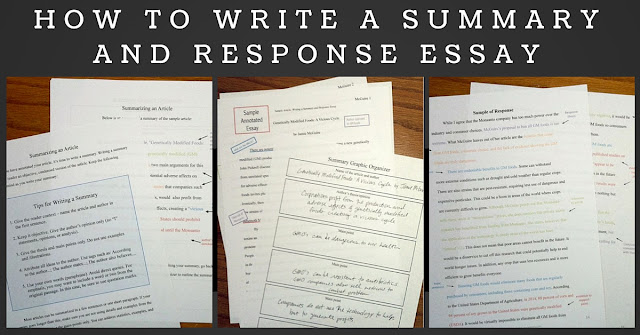
Before we begin a research paper in my composition classes, we start with a summary/response essay. I find that if students master the skills of the summary/response essay, they will be well prepared to take on the larger project because it breaks down the process of a research paper into manageable steps.

First, it requires a close reading of a qualified academic source. These types of sources are usually not easy reading, so it will push the students to pay close attention, annotate, make notes, and perhaps cross-check facts, and seek alternative opinions for background. I require an annotation of the chosen article for the first assignment for this essay.

Next comes a summary, which will become the first paragraph of the essay. A good summary follows these guidelines:

1. Gives Context: Name the author and title of the article in the first sentence. In the article xxx, by xxx, the author states......
2. Contains the main ideas only: The thesis and the main points of the article are all that is necessary in a summary. Leave out examples, illustrations, and details.
3. All ideas are attributed to the author: The reader should always be reminded that these are the ideas and thoughts of the author, not the essay writer. Jones believes......  or  According to Jones.....
4. Objective: The essay writer should offer no opinions or analysis in the summary. Statements such as Jones makes a good point when she says... are not objective, because "good point" is subjective.
5. Paraphrase: Use your own words. Direct quotes should be rarely used.

After the summary, the rest of the essay is structured like a traditional essay, with a thesis statement, body paragraphs and a conclusion. The difference is that the whole essay should stay tightly focused as a response to the article. A thesis statement might be structured something like this: Although Jones makes a strong argument about x, she does not consider x.  Or:  I agree with Jones about x, because this is a problem that is often overlooked in the mainstream media. 

I require students to quote or paraphrase from the article frequently in their response to make sure they stay focused. It's easy to stray far from the article, especially if the student has strong feelings or a lot of knowledge about the topic. By requiring this kind of focus, it helps students master the skill of integrating sources.

I also require students to use only the one source for this essay to keep it simple.

After the summary/response essay, students can directly transfer the skills to writing a research paper with multiple sources.

I've had great success with this type of essay in my classroom. Not only do students typically score well on this assignment, it gives them the confidence and skills to move forward.

If you would like a prepared summary and response unit, I have one here that includes samples of an annotation, summary, response and complete essay. It also includes step-by-step instructions for the whole process, along with worksheets, graphic organizers, grading rubrics, and  more.

https://www.teacherspayteachers.com/Product/Summary-and-Response-Essays-Complete-Unit-1729917

Tuesday, September 1, 2015

Descriptive Writing Prompts 2 - FREE

https://www.teacherspayteachers.com/Product/Descriptive-Writing-Picture-Prompts-2-1979379

Descriptive writing prompts are a great way to get a writing sample at the beginning of the year. They are also a good warm-up for a narrative essay, which I usually assign as a first essay in a basic composition class. The key is getting the students to write concrete, or sensory, detail instead of abstractions. Download this freebie for a short lesson plan and three of my new descriptive writing prompts appropriate for middle school and above:
https://www.teacherspayteachers.com/Product/Descriptive-Writing-Picture-Prompts-2-1979379

Tuesday, April 14, 2015

Point of View in Academic Writing - the Ubiquitous "You"


When reviewing student drafts of academic essays, I find myself constantly marking the use of second person. With no direction, I find most students use second person. With direction, I find most students still slip into second person.

There are many reasons why second person is the go-to point of view for first drafts. It is the most informal and conversational. Students tend to write like they talk, so second person is natural. They also read a lot of second person online; advice articles, how-to, and informal blogs tend to use second person.

Second person, however, is the point of view that should be almost never used in academic writing. Besides the informality, which is inappropriate in a research paper and other academic essays, the main reason second person is not preferable is because it excludes or alienates part of the audience.

I use a few humorous examples to show this, and that is when it usually clicks with students. For example, I first ask the students, "Who is the audience for this paper?" The typical answer is me, the teacher, but we also discuss that it is anyone who is interested in the topic. Then I read the following passage from a student paper about preventing teen pregnancy:

"You should discuss your sexual activity with your parents or another adult because studies show that if you do this, your chances of pregnancy go down significantly."

I ask the students if I should discuss my sexual activity with my parents or another adult. I also ask a male student if this advice will help reduce his chance of pregnancy. Of course they immediately understand my point, and we don't need to elaborate on how second person excludes part of your audience.

We also review how the tone of this passage is more like a self-help article than academic research. Then I show a simple rewrite:

"Teen girls who discuss their sexual activity with their parents or another adult have a significantly reduced rate of pregnancy" (Smith 21).

There will always be the ubiquitous "you" in student papers, but a simple example requiring students to think about their audience will help them revise correctly.


If you are looking for resources to teach point of view, here is the Power Point and rewriting exercises I use with my classes: 

https://www.teacherspayteachers.com/Product/Point-of-View-in-Academic-Writing-1798737

Sunday, January 4, 2015

Idiom Posters and Matching Game


http://www.teacherspayteachers.com/Product/Idiom-Posters-1623802http://www.teacherspayteachers.com/Product/Idiom-Matching-Cards-1630536


According to the common core standards, students learn idioms in second through fifth grade. I created these two products with those grades in mind, but I used more mature artwork and added some more sophisticated idioms into the mix so that teachers can use them for older, or even adult, ESL students. Idioms are hard to master for ESL students because they don't make literal sense, and are often cultural references. These posters and matching cards will hopefully help a broad range of students, and make learning fun.


Artwork by Image Boutique

Friday, December 5, 2014

Winter Holiday Freebies and Tips

http://www.teacherspayteachers.com/Product/2014-Winter-Holidays-Tips-and-Freebies-eBook-Grades-6-12-ELASS-Edition-1591294
Just posted! The 2014 Winter Holiday Tips and Freebies ebook. Specifically for Language Arts and Humanities, grades 6-12, you'll find tons of great free curriculum for your classrooms and tips to survive the days before the holidays. My page is included, and I have a link to a fun game you might want to keep in your playbook for a classroom full of squiggly students. Click here to download.

Thursday, October 9, 2014

Free Resources for Secondary Teachers

I am happy to say that my free Thesis Worksheet resource is now available. Brain Waves Instruction, Literary Sherri, and Getting Nerdy with Mel and Gerdy have compiled three free ebooks full of ready-to-print resources for secondary sellers. There are three ebooks, one for ELA, one for math and science, and one for humanities. My resource is included in the  ELA book, plus there is a link to it in my store at the bottom of this post. Each book contains 25 resources, plus a little bit about each seller and the kinds of resources he or she offers. Check them out here:
http://www.teacherspayteachers.com/Product/Meet-and-Teach-eBook-ELA-Grades-6-12-Free-1468027
http://www.teacherspayteachers.com/Product/Meet-and-Teach-eBook-Math-Science-Grades-6-12-Free-1466695

http://www.teacherspayteachers.com/Product/Meet-and-Teach-eBook-Humanities-Grades-6-12-Free-1466589


Here is a link to my resource that you can download for free in my store:

http://www.teacherspayteachers.com/Product/Thesis-Statement-Worksheet-Meet-and-Teach-1490524