Showing posts with label Language arts lessons. Show all posts

Tuesday, September 26, 2017

Extreme Sports Argumentative Writing Prompt


One of my favorite activities in class to practice a particular writing skill is to show a short video about a high-interest topic and then give the class a writing prompt after a class discussion. By far, the most engaging topic for this method is extreme sports. The videos are gripping, and everyone pays attention. 

Here are two videos on YouTube about the topic that I like to show together. The first one is some amazing footage of people doing some extreme sports. The second explores the psychology behind it. 

https://www.youtube.com/watch?v=uAz9hZmcr58


https://www.youtube.com/watch?v=9qEbjw_I0-o 

In the class discussion, we talk about why people engage in these sports, but also the risk, the cost of rescue operations, and the legality of some of the stunts. This discussion always leads to arguments (in a good way!) and therefore, the prompts are easy:  Should people be able to engage in high-risk sports in national parks? Should they be required to pay for search and rescue if they get in trouble? Should the deadliest sports be illegal or regulated? Why would someone want to engage in such a dangerous activity? Is the freedom to do what you want worth the risk to rescue personnel? 

I think you'll find a lively discussion on this topic and some excellent written responses.

If you would like to add some reading to supplement the topic, click on the photos below for informational articles on extreme sports. The reading level is grades 5 - 8, but because of the subject matter, they are appropriate for high school students as well. 


Tuesday, August 29, 2017

Every day vs. Everyday


The most common mistake I see in commercial signage, besides apostrophes, is using "everyday" instead of "every day." It drives me crazy because the difference is simple, and they mean different things. You would think that before a company would spend thousands of dollars printing their ads, they would have a proofreader look it over. Does this grate on anyone else's nerves as much as mine? Below are two of the latest offenders. Props to Firehouse Subs, though, for using an apostrophe appropriately in Kids' Combo.


It's also not unusual to find "everyday" and "every day" in student writing. No wonder, since the misuse is everywhere. Here's the simple rule, and a few examples to help ground them in their memories:

Everyday is an adjective that means "routine, usual, or mundane."  Examples: You don't want to wear your everyday clothes to the wedding.  Snow is an everyday event in the winter here.  Paper plates are our everyday dishes.

Every day means "each day."  Examples: I eat oatmeal for breakfast every day. Every day is a new start. Someone has to walk the dog every day.

To remember the difference, just remind students that if they can substitute "each day" then "every day" is correct. So the signs above should read "Kids 12 and Under Eat Free Every Day after 4 pm" and "Eat at least 6-8 servings of fruit and veggies every day."

Easy, right? Now if I could just stop seeing these mistakes every day!


Friday, November 25, 2016

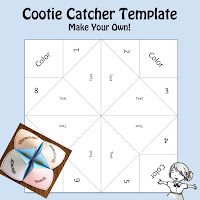
Cootie Catchers to Review Grammar


Let's face it: teaching and reviewing grammar with older students can be boring for the students and the teacher. Worksheets and power points just don't cut it. I'm a big fan of games that involve the whole class (see my blog post here for ideas), but recently I was looking for something that could work for pairs of students. I decided to take a chance on Cootie Catchers for my teen students. I called it "Throwback Thursday" because I was worried they would think it was silly or juvenile, but they instantly had smiles plastered on their faces, and more importantly, they were interested and engaged.

There are many ways to use Cootie Catchers. My favorite is to have a "speed round" where students, in pairs, go as quickly as they can to answer three different questions from a single Cootie Catcher correctly. When the first partner has done so, they switch places and the second partner has to answer three questions correctly from a different Cootie Catcher.  The first pair to finish wins.

Below are instructions for folding and using a Cootie Catcher, and some links to the ones I have made to review grammar. If you want to make your own, click here for a free template.


Tuesday, August 30, 2016

Avoiding Plagiarism Handout for Students


Plagiarism is a big problem in my classroom, and it probably is in yours, too. I do my best to teach the concepts; the students know how to avoid blatant copying, but they are often tripped up on the finer points.

Recycle a paper from a previous class? Nope. But it's my own work! Still nope. Paraphrase a source without a citation? Nope. But they are my own words! Still nope.

I made this handout so there could be no confusion. For the first paper after my complete lesson on avoiding plagiarism, I have them attach this sheet and sign it.  Ignorance of the rules (meaning they tuned me out when I was teaching!) is no longer an excuse.

You can download it for free by clicking on the cover below. I hope you find it useful in your classroom!


If you would like a complete lesson plan that includes comprehensive handouts, a worksheet, and a quiz, click on the cover below. Two versions are included: MLA and APA style.

Tuesday, August 16, 2016

High Interest Reading - Extreme Sports


Of all the original reading passages I've used in my classroom, the most popular, by far, have been on extreme sports. The appeal is obvious to the athletes, but even students with no interest in sports find the topic fascinating. Why would someone participate in such dangerous and extreme behavior? How did these sports start? What drives the athletes?

P.S. The man on the Slacklining cover is of my friend's son. He's a an out-of-the-box athlete who has also competed on America Ninja Warriors. He's only landed in the hospital once : )


Tuesday, February 2, 2016

Grammar Game for Secondary Students


This game is a hit every time I use it in class. There are few ways to teach grammar and have it really stick. This is one of them. The example here is for active and passive voice, but you can adapt it for parts of speech, sentence structure (have categories for fragments, complete sentences, and run-ons), or correct/incorrect usage of punctuation marks.

1. Divide a whiteboard, chalkboard, or bulletin board into two halves. Label one side “Active” and one side “Passive.”

2.  Pass out one or two sentences to each student. Tell the students that they have three rounds to get all the words in the correct category. (I offer a small treat, prize, or bonus points to the whole class if they can accomplish this.)

3. Have the students come up to the board and place each sentence where they think it belongs.

4. When all the sentences are in place, tell the students how many are incorrect.

5. Allow the students to study the board and discuss which are incorrect. Any student can move any of the sentences from one category to the other, as long as he or she offers an explanation. As they try to sort it out, this is where the learning comes in. It's also a learning experience for me When they are satisfied, tell them how many are incorrect, and give them one more round to work it out.  The hardest part will be for you to keep a poker face!

6. You may have to set a time limit for the rounds or give a few hints, but I find it usually works out well if the students are left to their own devices.  Go over the answers at the end, and discuss any that gave them trouble.


Saturday, October 18, 2014

Tips for Teaching Grammar When You're not Supposed to be Teaching Grammar


The composition class I have been teaching for years is supposed to be all about research, critical thinking, and honing argumentative writing techniques. The students, allegedly, have already mastered basic grammar and writing skills. After the diagnostic essays on the first day, however, the same story emerges: the grammar mastery is shaky at best, and non-existent at worst. Over time, the topics that need the most review have held steady, and my teaching has evolved to meet this need.

Most of my students have gaps in their early education, or are returning to school after many years, so I am not so concerned that every student knows what a dangling whoseewhatsit is, but they need to review or be taught some basics in order to begin to present a coherent argument. The rest of it can be taken care of through critiques on their rough drafts.  Through trial and error, and ultimately modest success, here are my best tips for teaching grammar when the class is supposed to be at the next level:

1. Couch everything as a "review" since you will have students for whom it is, indeed, review.

2. Even though it's a "review," start with the basic rules and don't assume previous knowledge.

3. Keep the terminology as basic as possible.

4. Start with a review of the parts of speech. I use a cooperative game for this one, and call it an "English Class Ice-Breaker," rather than a formal lesson.

5. Teach sentence fragments and clauses first, then move on to run-on sentences. These two items are the crux of most of the issues, and writing improves significantly with these two errors corrected.

6. Keep the lessons short and to the point. I use a short power point, handouts with the explanations they can study at home, and self-check practice quizzes.

7. Check for understanding with a self-check quiz. Offer to meet with the students who need more help or provide more resources. I often send students to interactive websites for practice.  My current favorite is chompchomp.com.

8. Have students keep an "error journal" where they keep track of where they are making mistakes on their rough drafts. This will help them be self-aware and hopefully, self-correcting.

9. Do short writing exercises to practice the skills your class is really about, but each time, give special emphasis to one point of grammar and grade accordingly.

I would love some feedback on how you teach grammar in the classroom under similar circumstances.

If you'd like to use my resources, which include power points, worksheets, handouts, games, quizzes, and two comprehensive assessments, I've put them altogether in a money-saving bundle. These are what I use each quarter in my class. I hope you find them useful.

http://www.teacherspayteachers.com/Product/Grammar-and-Punctuation-Pack-1496307

Monday, January 14, 2013

Clause Confusion

It's been a while since I taught clauses to my students, beyond dependent and independent clauses. The section in our book on the subject was not clear at all, and I felt like I needed to brush up on the topic myself anyway, so I started researching from different sources. Wow. I ended up completely confused. Not only does it seem there is no consensus on the major categories, but they are often called by different names.

So, I sifted through all the resources I could find, and after one big headache, boiled it down what I think is the latest and greatest thinking on the subject, and included the categories that made the most sense for students: Independent, Dependent, Relative, Nonrestrictive, and Restrictive. Although I looked at a plethora of sources, the one that most informed my choices was from the online library at the University of Phoenix.

This power point is a great starting point for clearing up clause confusion. It has explanations and clear examples. I used it in my classroom this quarter, and the test scores on the subject confirmed that it helped. I hope you will find it helpful, also.

Ho, ho, ho!

Tuesday, November 13, 2012

Evaluating Sources Prompt - Bottled Water

It's important to teach students to use qualified academic sources in their papers. The temptation is to use the easy, entertaining stuff they find on the internet instead. Here is a classroom activity to start a discussion and use as a writing prompt.

1. Show the video "The Story of Bottled Water."


2. After the video, have a brief discussion of the issues. Now show the video "The Real Story of Bottled Water."


3. Have a discussion on why or why not either of these are credible sources. (They are not--one is inflammatory, for example, it compares drinking bottled water to smoking while pregnant, and one is put out by a trade association with a commercial interest). Ask students what questions they have now, what information they can use or trust, and how to go about verifying facts and getting the real story.

4. At this point, I ask students to find a good academic source, and write a response to the issue based on the credible information they find.

An important concept the students learn is that unqualified sources such as the videos are good starting points for asking questions and learning what the conversation is all about, but that in order to be a good research, facts must be verified.

Wednesday, October 17, 2012

Writing Prompt - Videos for College Applications?


This week's writing prompt is about whether students think videos should be part of the college admission's process. Some universities are now accepting videos in lieu of, or in addition to, the traditional written essay component.

I have my students read an article about it, and then watch actual video submissions. The article is here. Links to the videos are embedded in the article, and two are below.

I would think that my students would embrace the idea of using videos instead of writing essays, but surprisingly, they seem to understand the importance of showing communication skills on paper. After a class discussion, I have them write for thirty minutes.

The purpose of this writing prompt in my classroom is to demonstrate competency in incorporating outside sources to back up opinions. Here is the actual assignment:


Please read the article about You Tube college applications and watch the video clips.

Write a one-page opinion piece (about 30 minutes effort) on whether or not you think videos should be part of the college application process and possibly even replace the written essay requirement. Use specific examples from the article and the videos.

Grading criteria:

30 minutes effort
Contains a clear opinion/thesis statement
Specific examples from the article and videos used to back up opinion.


Friday, October 5, 2012

Commonly Confused Words

For a long time, I've been collecting the words that students most often confuse or misspell so they end up with a different meaning. You'll find the obvious there/their/they're, and also more sophisticated vocabulary such as complement/compliment and precede/proceed. I finally put the list together, along with definitions and sample sentences.

This unit has a lot of flexibility to suit a variety of approaches. What I do is divide the students into groups and supply them with a list of words with worksheets for filling in definitions and sample sentences. Then, each group takes a turn once a week presenting their words to the rest of the group.

Also included are completed worksheets to use as a study guide, in case you want to use it that way.

A teacher who purchased this unit suggested that I also include worksheets with words and definitions, but blanks for sentences so students could come up with their own. I thought this was a great idea, so those are included also.

I made this with high school students in mind, but I've gotten feedback from middle school teachers who use it successfully, as well.

Tuesday, September 18, 2012

Paper Topic Brainstorming Activity

Coming up with a topic for a research paper is one thing, but figuring out a narrow direction to pursue is quite another, and one where students often get hung up. This activity uses the brainpower of the entire class to help find that direction.

Tape one large piece of paper for each student on the wall around the classroom. Give everyone a colored marker and have them stand in front of their papers. Ask everyone to write their topic in the center of the paper and circle it.

Now, have everyone rotate so they are standing in front of someone else's paper. Allow 30 seconds for students to write everything they can think of about the topic, using a mind-map style web. They can ask a question, add a subtopic, make a comment--whatever comes to mind.

Rotate again, and keep going until everyone has had a chance to respond to everyone else's topics. You will need to extend the time as the papers fill up, because it will take students longer to review what has already been written.

If you have a small classroom with no space for the paper on the wall, this activity works just as well using large paper (I used 11 x 17) passed along desktops. If you can, though, use the wall because it's  a great opportunity to get students up and moving, and if nothing else, it's fun to write on the wall.

At the end of the activity, each student can take their own paper and see what everyone else has to say. Perhaps they will find an interesting question or a direction they hadn't thought of before. My students find it very helpful, and some even switch topics to something else they found on the wall that seemed more interesting.


Wednesday, August 15, 2012

Teaching Active and Passive Voice


Recognizing the difference between active and passive voice doesn't come easy for some of my students, so I broke it down in a simple, visual way that has helped tremendously. The terminology of parts of speech can throw them off, too, so I use the words that make sense rather than the technical terms (although I teach those, too, for accuracy's sake.) To illustrate active voice, I draw this guy on the board:

 Andrew is eating the burrito.

I explain that we have the agent (or do-er) of the action first (Andrew), and the thing that is being acted upon second (the burrito).

For one passive voice construction, I draw the same image, only flipped, on the board:
 The burrito is being eaten by Andrew.

Now, the thing that is being acted upon (the burrito) comes first and the do-er is second. For the second passive construction, I just draw the burrito:
 The burrito was eaten.

Now, there is no do-er of the action. So for any simple sentence, I ask them to visual a picture according to the order laid out in the sentence, and unless the do-er of the action is first, it is a passive construction. By getting this simple foundation, the students are ready to move on to more complex construction and higher concepts. 

Here's the lesson plan I put together on this, which includes the above, plus some worksheets and a quiz. Now, I'm going to eat a burrito!