Showing posts with label English resources. Show all posts

Tuesday, October 10, 2017

Using APA format in the Secondary Classroom


The vast majority of English teachers in middle and high school teach MLA formatting for essays with good reason, as it is what students will most likely be required to use in their first year of college. It is the format used for English and the Humanities, after all. 

But after having taught entry-level writing at several different colleges, I found students won't always use MLA. At one college, all freshman were required to use APA, as the school's majors were primarily in the social sciences. APA formatting is the preferred format for the social sciences, and for many students with majors and careers in these fields, MLA will be nothing but a distant memory from high school.

Teaching APA on the secondary level is useful for several reasons. The most important, perhaps, is that when taught in addition to MLA, it will prepare students for college writing. It is good for students to understand that there are different styles for different types of writing. It will increase their flexibility in the different rhetorical strategies. 

Unlike MLA formatting, APA style includes headings and sections, which can lead to more thoughtful and intuitive organization. Assigning one of the two most common APA-style papers, literature review or experimental report, will give students excellent experience in these rhetorical modes. 

APA also has many writing style rules, which can seem overwhelming on the secondary level when we are trying to teach the basics of good writing, but I've found most of these style rules are already the things we are encouraging our students to do, such as writing in active voice instead of passive voice. When I teach APA to beginning composition students, we focus on the formatting and save the style rules for more advanced classes. 

There are plenty of APA guidelines online. My favorite is the Online Writing Lab at Purdue, but if you would like some resources on the basics meant for secondary students, I've got some for your here:


Tuesday, October 3, 2017

Success Writing Prompts - Four Rhetorical Strategies


There are a lot of good writing prompts out there that ask for an opinion, but there are few that ask for rhetorical strategies beyond that. I created this product to help students practice writing with different methods - expository, narrative, persuasive, and research-based. Each prompt has a quote from a famous person on an aspect of success, and then a writing prompt that promotes critical thinking. Students write in the mode specified at the top of the page. There are ten for each strategy.

I also created this product in three versions for maximum flexibility: print, digital (for Google Drive and MS One Drive), and a Power Point presentation. Whether you want to hand out copies for students to write on, have students write on the computer, or project a slide and have students use their own paper, you're covered. Click on the picture above or here to get to the product preview.


Tuesday, September 19, 2017

The 5 Essays You Must Master To Be College Ready


My new book is finally available! After many years of teaching college students who are not quite ready for the demands of college-level writing, I identified the information and practice that they needed in five different rhetorical strategies to be ready. This book incorporates my most successful classroom curriculum, modified for secondary students who are homeschooled or working with a tutor or parent to enhance their skills. 

This is a full program, with exercises, step-by-step processes for each essay type, samples, and clear essay assignments for each essay type. Writing teachers will also find valuable information and projects for their classes. I'll be using it as a textbook for my future classes. 

This baby has been years in the making, and I'm proud it's finally here! Click here to purchase. 


Tuesday, September 5, 2017

Discouraging Plagiarism


The bane of my existence in teaching is plagiarism. I do everything I can to explain to students why they should not plagiarize, and I spend a significant amount of time on making sure they know what it is. I even have them take a quiz on it before their first big paper. Despite all that, there are always the cheaters.

The luxury of being a writing teacher, however, is that I can usually discourage most of the cheating by requiring a process that would make it difficult to turn in a copied paper. Here is the process that I use (which is also just a good process for writing in general):

1.  I ask a specific question, perhaps comparing and contrasting two different articles, or limiting their choice of topic. This makes it harder to find something to copy that fits the prompt. I never assign an open-ended paper.

2. I require students to turn in sources ahead of time for approval. They are free to change their minds about the sources, but they must email me links to their new sources any time before the paper is due. Sometimes, if the topic is narrow enough, I supply one of the sources as a starting point and require that they include it.

3. I assign in-class, graded assignments for the paper. Perhaps students will write two or three introductions and then do group work to determine the best introduction for their papers. Maybe I will have them free write a body paragraph, or turn in a finished paragraph for feedback.

4. I always require a rough draft and rewrites. If they do not turn one in by the deadline, they still have to include one with their final paper, or they don't get any credit.

None of these alone will deter all plagiarism, but taken together, it would be more work to plagiarize the whole process than just writing a new paper.

Most important, however, is early intervention for someone who seems overwhelmed. If a student has been absent a lot and not turning in preliminary assignments or in-class work, I take them aside and ask how I can help, and gently work into the conversation that they must be careful not to panic and do something that they would regret later. In my experience, the students who plagiarize are those who have procrastinated or tried to do a last-minute paper and gave into the temptation to try the easy way out. I tell my classes frequently that anything they can accomplish is far better than anything they can copy.

Here are some resources to help your students understand plagiarism.  The first is a free checklist you can use in your classroom and the second is a complete teaching plan with explanations, examples, exercises and a quiz.


Tuesday, January 10, 2017

Out with the Comma? Joining Independent Clauses


It's seemingly one of the simple punctuation rules: When you join two independent clauses with a coordinating conjunction (aka FANBOYS), you need to separate them with a comma. Here is an example. The independent clauses are in blue. 

English has many grammar and punctuation rules, but there are many exceptions to those rules

This is what I've always taught in my classes, no exceptions. Now, however, I can't ignore the exception to this rule because it's becoming more common in publications, and my students notice. 

If the two independent clauses are short, closely related, and if the comma is omitted, there is no misunderstanding. For example: 

He completed the assignment but it was late.

It's not new; it's in the Chicago Manual of Style and the MLA Style Guide, among others, but it's been largely ignored and doesn't come up in most shorter official grammar guides.  

The trend is definitely toward minimal punctuation, so I'm getting on board teaching the exception, but only so my students will understand when they see it in print. I will, however,  require my students to continue to use the comma in their formal writing assignments so I'm sure they understand the rule, and it's not a purposeful omission. I explain that you can't go wrong with the comma. My students know my mantra: Learn the rules (and demonstrate your understanding) before you break them. 


Friday, November 25, 2016

Cootie Catchers to Review Grammar


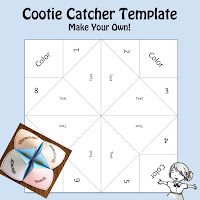
Let's face it: teaching and reviewing grammar with older students can be boring for the students and the teacher. Worksheets and power points just don't cut it. I'm a big fan of games that involve the whole class (see my blog post here for ideas), but recently I was looking for something that could work for pairs of students. I decided to take a chance on Cootie Catchers for my teen students. I called it "Throwback Thursday" because I was worried they would think it was silly or juvenile, but they instantly had smiles plastered on their faces, and more importantly, they were interested and engaged.

There are many ways to use Cootie Catchers. My favorite is to have a "speed round" where students, in pairs, go as quickly as they can to answer three different questions from a single Cootie Catcher correctly. When the first partner has done so, they switch places and the second partner has to answer three questions correctly from a different Cootie Catcher.  The first pair to finish wins.

Below are instructions for folding and using a Cootie Catcher, and some links to the ones I have made to review grammar. If you want to make your own, click here for a free template.


Friday, October 14, 2016

Short Story Speed Round Discussion Activity

Discussion questions are a great idea to kick off a short story unit, but the participation of my students has been lackluster with the traditional format. Enter a fast and fun discussion activity based on the speed dating concept. This will be my go-to activity on Halloween with a spooky Edgar Allan Poe story. 

Every student participates, and the stakes are low for exploring the answers to questions because they are working one-on-one with each other for short periods of time. It gets students up and moving, a rare thing when studying literature. Below are the rules of the activity. You'll have to make cards with discussion questions, or if you want to save time and check out mine for Poe's The Black Cat, click here.

1. Arrange students in one of the following ways:

A. Have students form two circles, one inside the other, with an equal number of students in each. Have students face each other.  
 or
B. Have students stand in two equal lines, facing each other.

(If you have an odd number of students, you can participate or rotate one student out each round.)

2. Divide the cards evenly among one line or one circle of students.

3. Start a timer for two minutes. The student with the cards reads the question from the first card, and then the students facing each other discuss the question.

4. When two minutes are up, have the circle or line of students without cards rotate to the left (for a line, have the last person come to the front of a line).  The students with the cards will put the used question at the bottom of their pile.

5. Repeat process for about 10 rounds, or as time permits.

If a student gets asked a duplicate question, the student with the cards skips to a new question.


This activity is perfect for starting a unit, or as a stand-alone activity. I'll be using "The Black Cat" this year on Halloween, as Poe is the master of combining spooky and gruesome. The psychology of the narrator and the symbols throughout leave a lot of room for spirited discussion. Another favorite is "An Occurrence at Owl Creek Bridge" by Ambrose Bierce. 

Tuesday, August 16, 2016

High Interest Reading - Extreme Sports


Of all the original reading passages I've used in my classroom, the most popular, by far, have been on extreme sports. The appeal is obvious to the athletes, but even students with no interest in sports find the topic fascinating. Why would someone participate in such dangerous and extreme behavior? How did these sports start? What drives the athletes?

P.S. The man on the Slacklining cover is of my friend's son. He's a an out-of-the-box athlete who has also competed on America Ninja Warriors. He's only landed in the hospital once : )


Tuesday, August 2, 2016

New MLA Guidelines - 8th Edition


When I heard the MLA guidelines were changing, the emotion I felt is best described as "Ack!"  I have spent countless hours teaching and developing resources for the seventh edition guidelines, and re-learning and changing my resources seemed like a laborious task.

When I ordered the new book, however, and sat down to read it, I immediately lost that bad feeling. Although I was comfortable with the old guidelines, I immediately saw the wisdom in the changes. In-text citations are the same, but gone are the days of the nitpicky works cited entries, where each type of resource had particular, not necessarily intuitive, specifications.

In a nutshell, the new guidelines for the Works Cited page ask for the most important features of each source. What should be included is flexible, based on the purpose of the source, and any source fits into the general formula. With more varied sources available with technology, it's a plus that you only need to know the basics to figure out how to document the entry.

Here is the list of items you should find, if applicable, for documentation, for any source:

Author
Title of source
Title of container (meaning the journal, magazine, search engine, television series etc...)
Other contributors (translator, editor, producer, etc...)
Version
Number
Publisher
Publication date
Location (URL or doi)

Once you've got these items, you can easily put together the citation, and you can add any additional helpful information.

In the MLA Handbook, they include a handy chart that also shows what punctuation to use after each entry. I've re-created the chart with some modifications for my classrooms.

For detailed information, examples, and an overall great free reference source, go to The Online Writing Lab at Purdue University: https://owl.english.purdue.edu/owl/resource/747/01/

I've also created a product with all the basics for the classroom: guidelines, examples, and charts for both in-text citations and the Works Cited entries. What I thought was going to be laborious turned into a labor of love!


Tuesday, July 26, 2016

MLA 8th Edition Resources


Here's a little video I made to show some of my MLA resources. If you have to teach MLA formatting and citations, either from scratch or just the 8th edition updates, these products will save you a lot of time and make it easy for the students. Click here to see my resources: http://bit.ly/MLAResources


Tuesday, September 8, 2015

Summary and Response Writing

https://www.teacherspayteachers.com/Product/Summary-and-Response-Essays-Complete-Unit-1729917
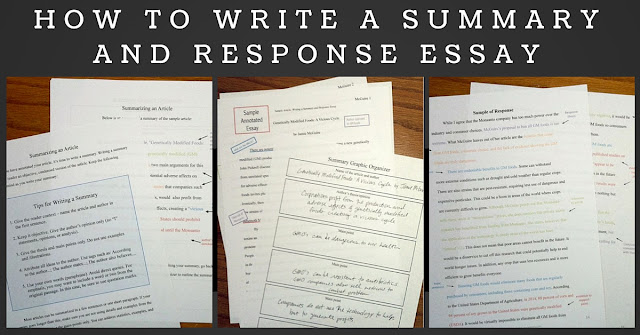
Before we begin a research paper in my composition classes, we start with a summary/response essay. I find that if students master the skills of the summary/response essay, they will be well prepared to take on the larger project because it breaks down the process of a research paper into manageable steps.

First, it requires a close reading of a qualified academic source. These types of sources are usually not easy reading, so it will push the students to pay close attention, annotate, make notes, and perhaps cross-check facts, and seek alternative opinions for background. I require an annotation of the chosen article for the first assignment for this essay.

Next comes a summary, which will become the first paragraph of the essay. A good summary follows these guidelines:

1. Gives Context: Name the author and title of the article in the first sentence. In the article xxx, by xxx, the author states......
2. Contains the main ideas only: The thesis and the main points of the article are all that is necessary in a summary. Leave out examples, illustrations, and details.
3. All ideas are attributed to the author: The reader should always be reminded that these are the ideas and thoughts of the author, not the essay writer. Jones believes......  or  According to Jones.....
4. Objective: The essay writer should offer no opinions or analysis in the summary. Statements such as Jones makes a good point when she says... are not objective, because "good point" is subjective.
5. Paraphrase: Use your own words. Direct quotes should be rarely used.

After the summary, the rest of the essay is structured like a traditional essay, with a thesis statement, body paragraphs and a conclusion. The difference is that the whole essay should stay tightly focused as a response to the article. A thesis statement might be structured something like this: Although Jones makes a strong argument about x, she does not consider x.  Or:  I agree with Jones about x, because this is a problem that is often overlooked in the mainstream media. 

I require students to quote or paraphrase from the article frequently in their response to make sure they stay focused. It's easy to stray far from the article, especially if the student has strong feelings or a lot of knowledge about the topic. By requiring this kind of focus, it helps students master the skill of integrating sources.

I also require students to use only the one source for this essay to keep it simple.

After the summary/response essay, students can directly transfer the skills to writing a research paper with multiple sources.

I've had great success with this type of essay in my classroom. Not only do students typically score well on this assignment, it gives them the confidence and skills to move forward.

If you would like a prepared summary and response unit, I have one here that includes samples of an annotation, summary, response and complete essay. It also includes step-by-step instructions for the whole process, along with worksheets, graphic organizers, grading rubrics, and  more.

https://www.teacherspayteachers.com/Product/Summary-and-Response-Essays-Complete-Unit-1729917

Tuesday, August 18, 2015

Free Back-to-School Resources and Tips ELA Ebook

https://www.teacherspayteachers.com/Product/Free-Back-to-School-English-Language-Arts-Grades-7-12-Sampler-2020179

This ebook is jam-packed with tips and free resources from Teachers Pay Teachers teacher-authors. You can download it for free by clicking here.


Here's my page, which is just one of 45. Each page has a tip, a free download, and a featured product. Thanks to Tracee Orman for putting this together!

Friday, July 31, 2015

Opinion Reading and Writing - Improving Critical Thinking Skills


In teaching remedial composition to college students, one misconception that I am constantly correcting is that academic research papers should not have an opinion. Au contraire. Any paper worth its salt is presenting and defending an argument which, of course, is an opinion.

At first, I was surprised at this misconception, and chalked it up to simply lack of exposure to this kind of reading. After more experience, however, I found it's more complicated than that, and a large part of it is in the semantics.

First, when students are learning to write in the early years, they are encouraged to preface opinions with "I think," "I feel," and "In my opinion" phrases. This is important in the process when students are learning to distinguish between fact and opinion. As writing becomes more sophisticated in middle and high school, however, these phrases are eliminated, making statements of opinion less obvious.

The second issue is how students define the word "opinion." Often, they think if a statement is labeled an "opinion" it is something that can't be proven or disproven by facts, such as which is the best restaurant in town. More advanced critical thinking, of course, quickly shows that even solid facts and research rarely conclusively prove anything. Many opinions on the same issue can be supported by facts.
https://www.teacherspayteachers.com/Product/Opinion-Reading-and-Writing-Should-Bottled-Water-be-Banned-1909012
The later elementary grades are a good time to explore these critical thinking skills. My favorite way to facilitate this is to have students do a close reading of two short opinion pieces that are research and fact based, one pro and one con. This helps clarify that different authors reach different conclusions about the same issues, even though the authors are privy to the same facts.  I like to have the students answer questions about each article, learn the critical vocabulary, and then bring it all together by deciding which author they agree with. Group work and class discussions further promote the skills.

To take it one step further, it's helpful to introduce a writing project in the form of a short five-paragraph essay. With this early introduction, students are on their way to developing the critical thinking skills that will serve them all the way through high school, college and beyond.

I've put together some packets that go through the process I described above. These are common-core based, with challenging reading for fourth and fifth grade (in the Lexile stretch bands) and at grade level for sixth and seventh grade.

https://www.teacherspayteachers.com/Product/Opinion-Reading-and-Writing-Bundle-2-1909076