Showing posts with label middle school language arts. Show all posts

Tuesday, August 7, 2018

Split Infinitives - To Teach or Not to Teach?


I vote "Teach" despite the fact it is not always wrong to split an infinitive.

Infinitives are an important part of English grammar. In fact, they are included in the common core standards for 8th grade Language, so although most grammarians nowadays will say to go ahead and split the infinitive, students should still understand the concept and decide when to split and when not to split (see what I did there?)

First, a refresher: the infinitive is the word "to" plus the verb.  For example, "to love." Splitting the infinitive means to put a modifier between "to" and the verb "love." For example: "to only love" instead of "only to love" or "to love only."

I recently heard a famous forensic linguist (I missed my calling in life!) say that the root of the rule for not splitting infinitives is illogical: In Latin, infinitives cannot be split because they are one word, so it followed that English infinitives should also not be split. He said, then, go ahead and ignore the rule because it makes no sense and we split infinitives all the time and are clearly understood.

He is correct on the second point (the first point - the origin of the rule - is in dispute), but I would say the rule must not be ignored, but understood and then applied or not according to the situation.

Most infinitives can be split and sound perfectly natural; in fact, sometimes it is necessary to avoid awkwardness or changing the meaning of the sentence.

For example, in the sentence "The farmer expects her crop to almost triple next season," the split is necessary because the modifier "almost" can't go anywhere else in the sentence and make sense or not sound awkward.

In addition, take our previous example of the infinitive "to love" and the modifier "only." Moving the word "only" around changes the meaning of the sentence:

Claire wants to only love you.

Claire wants only to love you.

Claire wants to love you only.

The three sentences have different meanings depending on the shade Claire's intentions, and the first requires a split infinitive.

So that leaves the question of whether we should teach students to avoid splitting infinitives when the meaning of the sentence is not affected.

For example:

Split:  "The coach expected us to quickly learn the drill."

Not split:  "The coach expected us to learn the drill quickly."

I make my students aware of the rule and call it a "best practice," as it sounds better "to the educated ear," as some grammarians put it, but I do not generally correct or mark a split infinitive if it's working well in the sentence. If there is a problem with a split infinitive, it is far easier to explain if they know the grammar and reasoning behind it.

Although you can avoid correcting split infinitives in students' work when it does not affect clarity, it is worth teaching what it is and how to make a conscious choice about its use to avoid a misplaced modifier or an awkward sentence.

In addition, on a purely practical level, if you are teaching for common core assessments on verbals, it is helpful for students who are asked to identify an infinitive to understand that it can be separated with modifiers.


Tuesday, November 14, 2017

Sojourner Truth Speech Writing Activity


Sojourner Truth's "Ain't I a Woman?" speech is short and powerful. I assign this reading during our argumentative essay writing unit and then we analyze it for logic and persuasive techniques.

I recently started assigning a writing activity to go along with it, and it was successful. I got some of the best writing out of my students all quarter because they wrote passionately.  Here's the prompt:

Write a short, logical, persuasive speech defending yourself against something you have been denied or a stereotype or misconception about you.

Some examples of something students have been denied are attending an event or place because of age, a request to a parent (allowance, pet, expensive clothes...), membership in a club, a job they applied for, or a class change. Examples of stereotypes of misconceptions are that video game players are lazy, people who get good grades are nerds, athletes are not smart, or girls are too dramatic.

My students had no problem coming up with something. In fact, many immediately started writing the second I finished writing the prompt. The examples I gave were light-hearted and some were silly, but some students wrote about very serious racial stereotypes and misconceptions, and they said it felt good to be able to communicate what they felt.

 Here's a link to "Ain't I a Woman?" if you want to give this a try:

https://sourcebooks.fordham.edu/mod/sojtruth-woman.asp


Tuesday, September 26, 2017

Extreme Sports Argumentative Writing Prompt


One of my favorite activities in class to practice a particular writing skill is to show a short video about a high-interest topic and then give the class a writing prompt after a class discussion. By far, the most engaging topic for this method is extreme sports. The videos are gripping, and everyone pays attention. 

Here are two videos on YouTube about the topic that I like to show together. The first one is some amazing footage of people doing some extreme sports. The second explores the psychology behind it. 

https://www.youtube.com/watch?v=uAz9hZmcr58


https://www.youtube.com/watch?v=9qEbjw_I0-o 

In the class discussion, we talk about why people engage in these sports, but also the risk, the cost of rescue operations, and the legality of some of the stunts. This discussion always leads to arguments (in a good way!) and therefore, the prompts are easy:  Should people be able to engage in high-risk sports in national parks? Should they be required to pay for search and rescue if they get in trouble? Should the deadliest sports be illegal or regulated? Why would someone want to engage in such a dangerous activity? Is the freedom to do what you want worth the risk to rescue personnel? 

I think you'll find a lively discussion on this topic and some excellent written responses.

If you would like to add some reading to supplement the topic, click on the photos below for informational articles on extreme sports. The reading level is grades 5 - 8, but because of the subject matter, they are appropriate for high school students as well. 


Tuesday, August 29, 2017

Every day vs. Everyday


The most common mistake I see in commercial signage, besides apostrophes, is using "everyday" instead of "every day." It drives me crazy because the difference is simple, and they mean different things. You would think that before a company would spend thousands of dollars printing their ads, they would have a proofreader look it over. Does this grate on anyone else's nerves as much as mine? Below are two of the latest offenders. Props to Firehouse Subs, though, for using an apostrophe appropriately in Kids' Combo.


It's also not unusual to find "everyday" and "every day" in student writing. No wonder, since the misuse is everywhere. Here's the simple rule, and a few examples to help ground them in their memories:

Everyday is an adjective that means "routine, usual, or mundane."  Examples: You don't want to wear your everyday clothes to the wedding.  Snow is an everyday event in the winter here.  Paper plates are our everyday dishes.

Every day means "each day."  Examples: I eat oatmeal for breakfast every day. Every day is a new start. Someone has to walk the dog every day.

To remember the difference, just remind students that if they can substitute "each day" then "every day" is correct. So the signs above should read "Kids 12 and Under Eat Free Every Day after 4 pm" and "Eat at least 6-8 servings of fruit and veggies every day."

Easy, right? Now if I could just stop seeing these mistakes every day!


Tuesday, January 10, 2017

Out with the Comma? Joining Independent Clauses


It's seemingly one of the simple punctuation rules: When you join two independent clauses with a coordinating conjunction (aka FANBOYS), you need to separate them with a comma. Here is an example. The independent clauses are in blue. 

English has many grammar and punctuation rules, but there are many exceptions to those rules

This is what I've always taught in my classes, no exceptions. Now, however, I can't ignore the exception to this rule because it's becoming more common in publications, and my students notice. 

If the two independent clauses are short, closely related, and if the comma is omitted, there is no misunderstanding. For example: 

He completed the assignment but it was late.

It's not new; it's in the Chicago Manual of Style and the MLA Style Guide, among others, but it's been largely ignored and doesn't come up in most shorter official grammar guides.  

The trend is definitely toward minimal punctuation, so I'm getting on board teaching the exception, but only so my students will understand when they see it in print. I will, however,  require my students to continue to use the comma in their formal writing assignments so I'm sure they understand the rule, and it's not a purposeful omission. I explain that you can't go wrong with the comma. My students know my mantra: Learn the rules (and demonstrate your understanding) before you break them. 


Sunday, October 16, 2016

Secondary ELA Seasonal Blog Hop: Composition Classroom Shares Halloween Activities

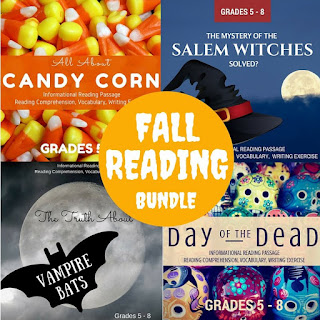
I like to bring in seasonal reading around Halloween more than any other time of year. Students are bombarded with the myths and traditions of Halloween, so I like to bring in some good non-fiction reading that helps them understand and think critically about some of these things. Where did candy corn come from? Are vampire bats really the scary, blood-sucking creatures portrayed in the movies? Here is my seasonal reading pack with four high-interest non-fiction passages, reading comprehension questions, vocabulary, and creative writing prompts. 
For my older students, I like an Edgar Allan Poe spooky story and an accompanying class discussion. To make it fun, I use a fast-paced activity based on the speed dating concept. You can use it for any short story. All you need are discussion questions and the instructions on my blog post here. Or you can get my questions and the story "The Black Cat" by clicking on the cover below.

What's a holiday without treats? I teach an evening class on Mondays, and this year, we'll be stuck there on Halloween, so I'll be making candied popcorn topped with these tags. Easy and cheap. Click here for a blog post with the recipe here, and click on the cover below to download the tags for free.

Happy, happy Halloween!


Friday, October 14, 2016

Short Story Speed Round Discussion Activity

Discussion questions are a great idea to kick off a short story unit, but the participation of my students has been lackluster with the traditional format. Enter a fast and fun discussion activity based on the speed dating concept. This will be my go-to activity on Halloween with a spooky Edgar Allan Poe story. 

Every student participates, and the stakes are low for exploring the answers to questions because they are working one-on-one with each other for short periods of time. It gets students up and moving, a rare thing when studying literature. Below are the rules of the activity. You'll have to make cards with discussion questions, or if you want to save time and check out mine for Poe's The Black Cat, click here.

1. Arrange students in one of the following ways:

A. Have students form two circles, one inside the other, with an equal number of students in each. Have students face each other.  
 or
B. Have students stand in two equal lines, facing each other.

(If you have an odd number of students, you can participate or rotate one student out each round.)

2. Divide the cards evenly among one line or one circle of students.

3. Start a timer for two minutes. The student with the cards reads the question from the first card, and then the students facing each other discuss the question.

4. When two minutes are up, have the circle or line of students without cards rotate to the left (for a line, have the last person come to the front of a line).  The students with the cards will put the used question at the bottom of their pile.

5. Repeat process for about 10 rounds, or as time permits.

If a student gets asked a duplicate question, the student with the cards skips to a new question.


This activity is perfect for starting a unit, or as a stand-alone activity. I'll be using "The Black Cat" this year on Halloween, as Poe is the master of combining spooky and gruesome. The psychology of the narrator and the symbols throughout leave a lot of room for spirited discussion. Another favorite is "An Occurrence at Owl Creek Bridge" by Ambrose Bierce. 

Tuesday, October 11, 2016

Pay for Grades?


Should kids get paid for good grades? As a parent, I did not offer any incentive for good grades, other than a trip out for ice cream on report card day. It was part of an overall philosophy about kids learning to be responsible without a dangling carrot. Along the same line, I never paid for regular chores, either. Doing well in school and pushing back your fair share of the dirt was just a basic expectation. This seemed to work, and I patted myself on the parental back.

Then along came some life experiences where I realized that my kids were a certain personality type that worked well with this kind of parenting. They had internal motivation to excel. I never had to remind them to do their homework, let alone nag, or come to the point where I considered offering incentives. Enter the life experience. What to do with students who lack the internal motivation? What to do with students who can't be encouraged or cajoled into doing their homework? What to do with students who didn't even care if they graduated from high school?

I started to read and study about motivation and incentives. The research is all over the place, and sometimes contradictory. Consider the different studies over the years cited by the good folks at Freakonomics. One study showed a program administered by a school offering cash and incentives for improved grades at the end of each term was marginally successful, at best. With only external motivations, and lacking intristic motivation, the incentives mostly failed. Another study showed that immediate gratification improved test scores. Dangle a $20.00 bill for a good test score, and scores improve. Better yet, tell the students they have $20.00, which will be taken away if they don't score well, and the improvement is even better.

The question remains, then, whether these immediate incentives pay off in the long run, or whether they damage the internal motivation. Many studies I've read, not related to grades, show that generally, when people think they are doing something to help someone else they perform better and complete the task more often than if they are receiving a cash reward.  I believe this, and I tend to think cash motivation for grades do more harm than good, for most kids, including the risk of creating a feeling of entitlement. I have learned, however, that one philosophy does not fit all. For students who lack the internal motivation, it might serve them best to offer the carrots to make some progress.

This is an interesting discussion to have with your students. I'm always curious to know what other parents do, and to compare and contrast how my students are motivated. When I've used this topic in my classes, I'm always surprised how much self-knowledge even younger students have about what makes them successful (or not).  I'm curious to know what you think, too. Do you reward your own kids for good grades? How about the students in your classroom? What works?

I've put together a packet with a pro and con article on this topic at the fifth through seventh grade reading level (Lexile leveled) if you think this would be of interest to your students.  It has plenty of options for classwork, group work, and writing assignments.


Tuesday, October 4, 2016

Fall and Halloween Reading


Fall and Halloween are the perfect time to bring seasonal reading into the classroom. These packets contain high-interest reading topics relating to Fall and Halloween. They also have reading comprehension questions, vocabulary work, and a creative writing prompt. The reading level is in the Lexile stretch band for fifth grade through the basic level for eighth grade. These are zero-prep, so you will have more time to enjoy this spooky season!