Showing posts with label reading comprehension. Show all posts

Sunday, October 16, 2016

Secondary ELA Seasonal Blog Hop: Composition Classroom Shares Halloween Activities

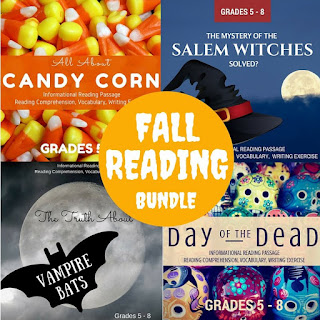
I like to bring in seasonal reading around Halloween more than any other time of year. Students are bombarded with the myths and traditions of Halloween, so I like to bring in some good non-fiction reading that helps them understand and think critically about some of these things. Where did candy corn come from? Are vampire bats really the scary, blood-sucking creatures portrayed in the movies? Here is my seasonal reading pack with four high-interest non-fiction passages, reading comprehension questions, vocabulary, and creative writing prompts. 
For my older students, I like an Edgar Allan Poe spooky story and an accompanying class discussion. To make it fun, I use a fast-paced activity based on the speed dating concept. You can use it for any short story. All you need are discussion questions and the instructions on my blog post here. Or you can get my questions and the story "The Black Cat" by clicking on the cover below.

What's a holiday without treats? I teach an evening class on Mondays, and this year, we'll be stuck there on Halloween, so I'll be making candied popcorn topped with these tags. Easy and cheap. Click here for a blog post with the recipe here, and click on the cover below to download the tags for free.

Happy, happy Halloween!


Tuesday, October 4, 2016

Fall and Halloween Reading


Fall and Halloween are the perfect time to bring seasonal reading into the classroom. These packets contain high-interest reading topics relating to Fall and Halloween. They also have reading comprehension questions, vocabulary work, and a creative writing prompt. The reading level is in the Lexile stretch band for fifth grade through the basic level for eighth grade. These are zero-prep, so you will have more time to enjoy this spooky season!


Tuesday, August 16, 2016

High Interest Reading - Extreme Sports


Of all the original reading passages I've used in my classroom, the most popular, by far, have been on extreme sports. The appeal is obvious to the athletes, but even students with no interest in sports find the topic fascinating. Why would someone participate in such dangerous and extreme behavior? How did these sports start? What drives the athletes?

P.S. The man on the Slacklining cover is of my friend's son. He's a an out-of-the-box athlete who has also competed on America Ninja Warriors. He's only landed in the hospital once : )


Monday, October 19, 2015

Halloween ELA Activities for Middle School and High School

 Halloween is the perfect time to bring some seasonal materials into your lesson plan. Here are some great ideas I found that you might be interested in:

Bright Hub Education has a list of activities that you can use with Poe's "The Tell Tale Heart." They are suitable for many grade levels. Here is the link: Language Arts Halloween Activities with "The Tell Tale Heart."

Mrs. Waters' English has a list of scary stories along with activities for middle school, but most are appropriate for high school and college, as well. Here is the link: 21 Scary Halloween Short Stories for Middle School.

The New York Times Learning Network has an extensive list of Halloween-themed ELA activities including opinion writing prompts and poetry. Here is the link: The Learning Network: Halloween

I have four reading packets in my store suitable for grades 5 - 8 with Fall and Halloween themes. Each contain close reading passages, with reading comprehension questions, vocabulary work and fun writing prompts. The reading level is grades six and seven. They are in the Lexile stretch band for fifth grade, and the basic level for eighth grade.


Happy Halloween!

Friday, July 31, 2015

Opinion Reading and Writing - Improving Critical Thinking Skills


In teaching remedial composition to college students, one misconception that I am constantly correcting is that academic research papers should not have an opinion. Au contraire. Any paper worth its salt is presenting and defending an argument which, of course, is an opinion.

At first, I was surprised at this misconception, and chalked it up to simply lack of exposure to this kind of reading. After more experience, however, I found it's more complicated than that, and a large part of it is in the semantics.

First, when students are learning to write in the early years, they are encouraged to preface opinions with "I think," "I feel," and "In my opinion" phrases. This is important in the process when students are learning to distinguish between fact and opinion. As writing becomes more sophisticated in middle and high school, however, these phrases are eliminated, making statements of opinion less obvious.

The second issue is how students define the word "opinion." Often, they think if a statement is labeled an "opinion" it is something that can't be proven or disproven by facts, such as which is the best restaurant in town. More advanced critical thinking, of course, quickly shows that even solid facts and research rarely conclusively prove anything. Many opinions on the same issue can be supported by facts.
https://www.teacherspayteachers.com/Product/Opinion-Reading-and-Writing-Should-Bottled-Water-be-Banned-1909012
The later elementary grades are a good time to explore these critical thinking skills. My favorite way to facilitate this is to have students do a close reading of two short opinion pieces that are research and fact based, one pro and one con. This helps clarify that different authors reach different conclusions about the same issues, even though the authors are privy to the same facts.  I like to have the students answer questions about each article, learn the critical vocabulary, and then bring it all together by deciding which author they agree with. Group work and class discussions further promote the skills.

To take it one step further, it's helpful to introduce a writing project in the form of a short five-paragraph essay. With this early introduction, students are on their way to developing the critical thinking skills that will serve them all the way through high school, college and beyond.

I've put together some packets that go through the process I described above. These are common-core based, with challenging reading for fourth and fifth grade (in the Lexile stretch bands) and at grade level for sixth and seventh grade.

https://www.teacherspayteachers.com/Product/Opinion-Reading-and-Writing-Bundle-2-1909076


Monday, February 4, 2013

SQ3R Note Taking Method Handouts


Here is a an SQ3R (Survey, Question, Read, Recite, Review) handout and worksheet to help students with effective note-taking and recall. This is a proven method that's worked well in my classroom. It's especially helpful to keep students on task when there is a significant chunk of reading. Having a structure and a plan for studying helps students feel less overwhelmed. Click here or on the picture to download an explanatory handout and the SQ3R template.