Showing posts with label classroom tool. Show all posts

Tuesday, August 22, 2017

Learning Students' Names (and more!) Activity


I am a big proponent of learning students' names early on, and several studies bear out the importance of this. In a recent small study of students in a large class, 85% said it was important to them that instructors know their name, but 80% of the students said it was "unlikely" that the instructors could name them. Not only did the students say they felt more valued when instructors knew their name, but they were also more likely to ask for help. I'm on board for that!

In the past, the most effective method I've used is taking their pictures in groups with each person holding a piece of paper with their name. (See my blog post about this here.)

I recently read about another method that sounds even better that I'm going to try this Fall, where each student glues a picture of him or herself to a notecard and gives their basic information. I'll modify this by making it a class activity at the end of the first week. I'll take group pictures the first day (many students don't have access to a color printer) and have them cut out their face and glue it to a half sheet of paper with questions on it. I'll include questions to help me also get insight into how I can be the most helpful in their learning process.

Here's an example of what they will look like:


I like the idea of memorizing not only their names, but a little about each student. The extra effort will pay off for everyone.


Tuesday, August 8, 2017

Fidget Spinners in the Classroom


Fidget spinners are everywhere, but do they belong in the classroom? Some say yes, as they are thought to help students with ADHD, anxiety, stress, or autism focus better on their lessons. The hard evidence is purely anecdotal, however, and teachers are likely to say they have the opposite effect, creating distraction instead of concentration. 

There is evidence that fidget devices can help a certain population. Studies have been done that show positive results with small, hand-held items such as putty, stress balls, or even a smooth stone. It stands to reason that fidget spinners could have the same effect, but who is to judge who truly benefits, and who is just playing? A second problem is that unlike these other objects, fidget spinners have a visual component. The spinning, whirring, colorful device is hard not to watch, and that's compounded by the fact that they are excellent tools for doing tricks.

Almost 11 percent of kids ages 4 to 17 have been diagnosed with ADHD, and many more are undiagnosed. Add to that the number of kids with anxiety, stress, or autism who could also benefit from a fidget item, it's hard to dismiss the possibilities of improved focus for this many kids. Some teachers, however, think they amount to nothing but trouble. One sixth grade teacher famously called them "helicopters of distraction" in a blog post that went viral.

Whether or not teachers allow fidget spinners or other fidget items in the classroom is becoming a school- and district-wide issue, with some banning fidget spinners outright. Other schools are leaving it up to each teacher to decide what's best for his or her classroom. 

If you want to put the question to your students, I've created two non-fiction articles, pro and con, along with reading comprehension, vocabulary, and writing assignments to help them come informed, reasoned opinions. The reading level is challenging fifth grade through standard seventh grade. 


Friday, November 25, 2016

Cootie Catchers to Review Grammar


Let's face it: teaching and reviewing grammar with older students can be boring for the students and the teacher. Worksheets and power points just don't cut it. I'm a big fan of games that involve the whole class (see my blog post here for ideas), but recently I was looking for something that could work for pairs of students. I decided to take a chance on Cootie Catchers for my teen students. I called it "Throwback Thursday" because I was worried they would think it was silly or juvenile, but they instantly had smiles plastered on their faces, and more importantly, they were interested and engaged.

There are many ways to use Cootie Catchers. My favorite is to have a "speed round" where students, in pairs, go as quickly as they can to answer three different questions from a single Cootie Catcher correctly. When the first partner has done so, they switch places and the second partner has to answer three questions correctly from a different Cootie Catcher.  The first pair to finish wins.

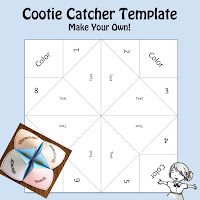
Below are instructions for folding and using a Cootie Catcher, and some links to the ones I have made to review grammar. If you want to make your own, click here for a free template.


Tuesday, February 2, 2016

Grammar Game for Secondary Students


This game is a hit every time I use it in class. There are few ways to teach grammar and have it really stick. This is one of them. The example here is for active and passive voice, but you can adapt it for parts of speech, sentence structure (have categories for fragments, complete sentences, and run-ons), or correct/incorrect usage of punctuation marks.

1. Divide a whiteboard, chalkboard, or bulletin board into two halves. Label one side “Active” and one side “Passive.”

2.  Pass out one or two sentences to each student. Tell the students that they have three rounds to get all the words in the correct category. (I offer a small treat, prize, or bonus points to the whole class if they can accomplish this.)

3. Have the students come up to the board and place each sentence where they think it belongs.

4. When all the sentences are in place, tell the students how many are incorrect.

5. Allow the students to study the board and discuss which are incorrect. Any student can move any of the sentences from one category to the other, as long as he or she offers an explanation. As they try to sort it out, this is where the learning comes in. It's also a learning experience for me When they are satisfied, tell them how many are incorrect, and give them one more round to work it out.  The hardest part will be for you to keep a poker face!

6. You may have to set a time limit for the rounds or give a few hints, but I find it usually works out well if the students are left to their own devices.  Go over the answers at the end, and discuss any that gave them trouble.


Sunday, January 4, 2015

Idiom Posters and Matching Game


http://www.teacherspayteachers.com/Product/Idiom-Posters-1623802http://www.teacherspayteachers.com/Product/Idiom-Matching-Cards-1630536


According to the common core standards, students learn idioms in second through fifth grade. I created these two products with those grades in mind, but I used more mature artwork and added some more sophisticated idioms into the mix so that teachers can use them for older, or even adult, ESL students. Idioms are hard to master for ESL students because they don't make literal sense, and are often cultural references. These posters and matching cards will hopefully help a broad range of students, and make learning fun.


Artwork by Image Boutique

Tuesday, August 26, 2014

Punch Game

Once in a while, I like to do something a little silly to add interest to an otherwise dry lesson plan. This is a game I've used before to spice up grammar lessons and review for final tests. It takes a little time to prep, but you can re-use it for years to come.

On a piece of foam core, hot glue plastic cups in rows, leaving at least a half inch between the rims of each cup.
 When the glue is set, you can put a question, task, or review question in each cup. I like to add a different treat along with each question and a few "free passes."

Cut squares of tissue paper and use a rubber band to secure them to around the top of the cups.
Here is one I made for a church class (Primary). When you call a student up, he or she has to choose a cup and punch through the tissue to get to the question (and treat).

An alternative use it fill it with prizes and let students punch on their birthday or after certain goals are met.

The element of surprise and the carnival feel of this game will be sure to add a little extra fun to your classroom!


Monday, February 25, 2013

Figurative Language Posters


When teaching figurative language to students, I find a visual really helps them get the concept. I asked my artist daughter to help me make some posters that would be fun and memorable. Here they are for you to use in your classroom. This free set includes metaphor, simile, alliteration, oxymoron, and personification. Click here or on one of the images to download the posters.


If you like these and want more, I have a set for $4.50 that also includes hyperbole, allusion, onomatopoeia, metonymy, and euphemism. This set also includes the illustrations without the titles so you can use them for a quiz or review for your students. You can find the set of 20 posters here.

Friday, February 15, 2013

Common Core Organizing System


Where I teach, we have standards very similar to the common core standards. My system for keeping track of my materials was a bit haphazard, to say the least. What was especially unorganized were all my handouts and online files. I decided to get organized, and after developing this 3-ring binder system, I cut my prep time down significantly. I created a page for each standard, written out, that serves as a cover sheet in a binder. Next comes a planning sheet where I write down my lesson plans and the location of online files, powerpoints, videos etc...Then I list handouts and any reading from textbooks. Hard copies of handouts go behind the planning sheet.

This worked so well for me, I decided to create the same thing with 6 - 12 grade common core language arts standards. It was labor-intensive, but the results are well worth it! I've gotten great feedback so far from teachers who are implementing this system. So, if you want to get organized, save yourself the time -- I've done the work for you! Click on any of the covers below to get to the product page.


Monday, February 4, 2013

SQ3R Note Taking Method Handouts


Here is a an SQ3R (Survey, Question, Read, Recite, Review) handout and worksheet to help students with effective note-taking and recall. This is a proven method that's worked well in my classroom. It's especially helpful to keep students on task when there is a significant chunk of reading. Having a structure and a plan for studying helps students feel less overwhelmed. Click here or on the picture to download an explanatory handout and the SQ3R template.

Wednesday, December 12, 2012

Cool Tool for Checking for Understanding

It's important to periodically check for understanding during a lesson, but often a teacher gets blank stares instead of helpful feedback. I heard of making these student "whiteboards" from a colleague, and it's made all the difference. Simple insert a white piece of paper or card stock in a page protector. Then supply dry erase markers (or have students provide their own) and a paper towel, and you have portable, erasable boards. When I'm explaining a concept, I'll often stop and ask an on-the-spot quiz question and have students write their answers on their boards and hold them up. This way, I can see at a glance how many are getting it. Better yet, it engages the students and most happily participate.